

For many Canadians over 55, most of their wealth is tied up in their home. A reverse mortgage lets you turn part of that equity into cash without selling and without making monthly payments. That can make retirement much more comfortable, but it comes at a cost: higher interest rates and a loan balance that grows every year.
Here is how a reverse mortgage works in Canada, its main pros and cons, what it really costs and which alternatives to compare before you sign.
What Is a Reverse Mortgage?
A reverse mortgage is a loan secured by your home that you do not repay until you sell, move out or pass away. Instead of paying the lender each month, the interest is added to the loan, so the amount you owe grows over time.
According to the Financial Consumer Agency of Canada (FCAC), in most cases:
- You must be 55 or older, and so must everyone on the title.
- You can borrow up to 55% of your home’s current value. The exact amount depends on your age, your home’s value, type and condition, and the lender.
- The home must be your primary residence, which usually means you live there at least six months a year.
You can take the money as a single lump sum, as a smaller lump sum followed by advances over time, or as regular payments, such as $1,000 a month. Reverse mortgages in Canada are offered by HomeEquity Bank (the CHIP Reverse Mortgage), Equitable Bank, Home Trust and Bloom Finance, some of them only through mortgage brokers and only in certain provinces.
Source: Financial Consumer Agency of Canada – Reverse mortgages
The Pros of a Reverse Mortgage
1. No Regular Mortgage Payments
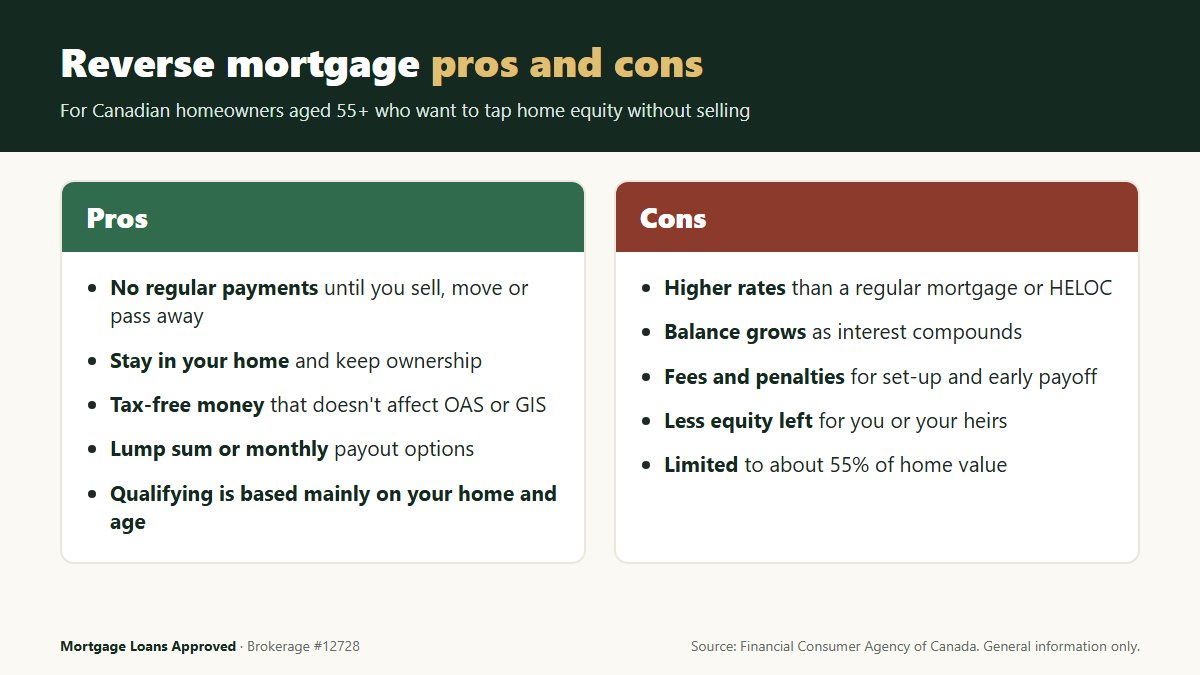
This is the biggest advantage. You do not have to make monthly payments for as long as you live in the home and meet the terms of the loan. That can free up cash flow if your pension and savings do not stretch far enough.
2. You Stay in Your Home and Keep Ownership
You keep the title to your home and can stay in the neighbourhood you know, close to family, friends and doctors. You also keep any future increase in your home’s value, minus what you owe.
3. Tax-Free Money That Does Not Affect OAS or GIS
Because the money is a loan, not income, it is not taxed. The FCAC also notes that it does not affect your Old Age Security (OAS) or Guaranteed Income Supplement (GIS) benefits.
4. Easier to Qualify For
A regular mortgage or home equity line of credit (HELOC) requires you to prove you can afford the payments. A reverse mortgage is based mainly on your age and your home’s value, so it can work for retirees whose income is too low to qualify for other borrowing.
5. Flexible Ways to Receive the Money
You can pay off debts or fund a renovation with a lump sum, or set up regular payments to top up your retirement income. Some lenders also let you take further advances later.
6. Protection From Owing More Than Your Home Is Worth
Major lenders such as HomeEquity Bank and Equitable Bank say you will never owe more than your home’s fair market value when the loan is repaid, as long as you meet the terms of your mortgage. Ask any lender to confirm this in writing.
The Cons of a Reverse Mortgage
1. Higher Interest Rates
Reverse mortgage rates are higher than rates on regular mortgages and HELOCs. In late 2026, advertised reverse mortgage rates ranged from roughly 6.2% to 7.6%, depending on the lender and term, compared with about 5% for many regular five-year fixed mortgages.
2. The Balance Grows Quickly
Because you make no payments, interest is charged on the interest. A balance can roughly double in about 10 years at today’s rates. The example below shows how $200,000 borrowed at 7% grows if nothing is repaid:
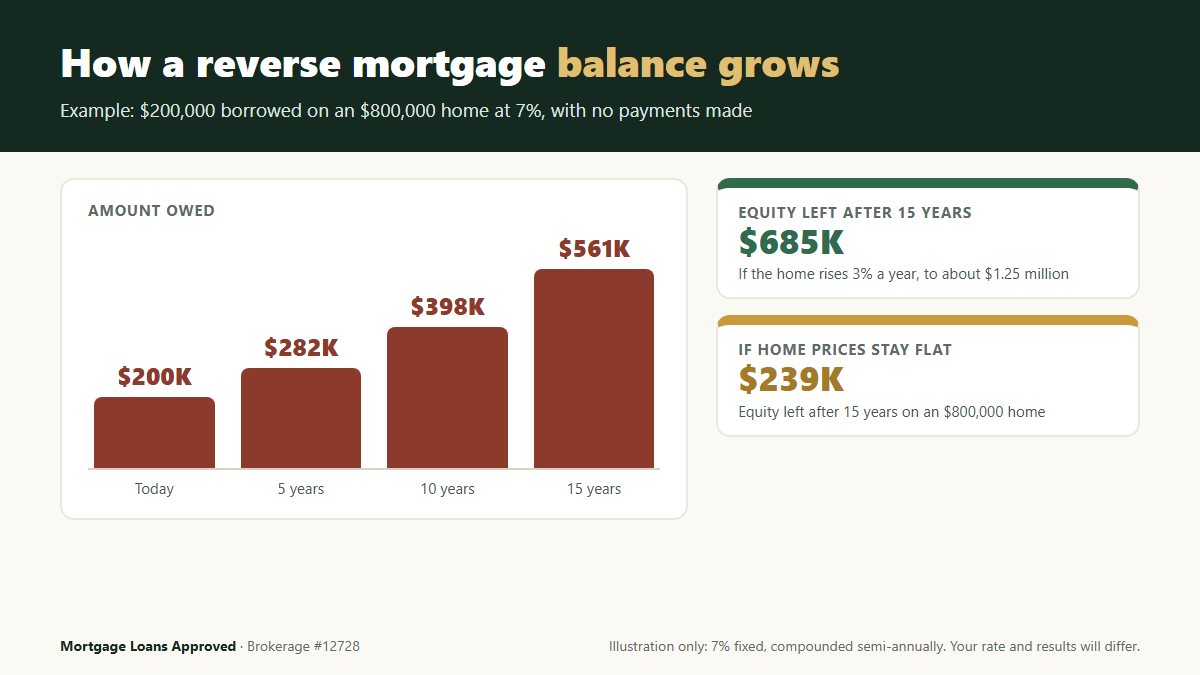
If your home’s value keeps rising, you may still have plenty of equity left. If prices stay flat or fall, the growing loan can take up most of it.
3. Set-Up Fees and Closing Costs
Expect to pay an appraisal, independent legal advice and a set-up or closing fee. Advertised set-up fees range from about $995 to $2,995 depending on the lender and product, and some lenders deduct them from your loan.
4. Prepayment Penalties
Reverse mortgages are designed to last until you sell or move. If you repay early, for example because you move into a retirement home after a few years, you may pay a penalty. Penalties are usually highest in the first three to five years. Some lenders let you repay a portion each year without a penalty. Learn more in our guide to mortgage prepayment privileges and penalties.
5. Less Equity for You and Your Heirs
Every dollar of interest reduces the equity left for you, your spouse or your children. If you later need money for long-term care, there may be less left to draw on. Talk to your family before you decide.
6. Your Estate Must Repay It Quickly
When the last borrower dies, the loan must be repaid within a set time, which the FCAC notes may be shorter than the time it takes to settle an estate. That can put pressure on your family to sell quickly.
7. You Must Keep Up the Home
You still have to pay property taxes and home insurance and keep the home in good repair. Not doing so can put the loan in default.
Sources: FCAC – Reverse mortgages, NerdWallet Canada – Reverse mortgages in Canada, WOWA – Reverse mortgage rates in Canada
Reverse Mortgage vs. Other Ways to Use Your Home Equity
A reverse mortgage is only one way to access your equity. Compare it with these options:
| Option | How much you can access | Monthly payments | Best for |
|---|---|---|---|
| Reverse mortgage | Up to 55% of home value | None | Homeowners 55+ who want to stay put and cannot afford payments |
| HELOC | Up to 65% of home value (80% with a mortgage) | At least interest-only | Flexible borrowing at a lower rate if you have the income to qualify |
| Refinance | Up to 80% of home value | Yes, principal and interest | A lower rate and lump sum if you can afford regular payments |
| Downsizing | Your full equity, minus selling and moving costs | None, or a smaller mortgage | Homeowners ready to move to a smaller or cheaper home |
For more on the differences, see HELOC vs. second mortgage in Ontario and our home equity solutions.
Source: CMHC – Mortgage financing options for people 55 and above
Who Is a Reverse Mortgage Right For?
A reverse mortgage can make sense if you:
- Are 55 or older and plan to stay in your home for many years
- Have significant home equity but limited retirement income
- Cannot qualify for, or do not want, regular monthly payments
- Want to pay off debt, renovate for aging in place or help family now
It is usually not the best choice if you:
- Expect to sell or move within the next few years
- Can qualify for a HELOC or refinance at a lower rate
- Need only a small amount of money for a short time
- Want to leave as much of your home’s value as possible to your heirs
Questions to Ask Before You Sign
- What is the interest rate, is it fixed or variable, and how often does it compound?
- What are all the fees, and are they deducted from my loan?
- What is the prepayment penalty if I sell or move early?
- What happens if I owe more than my home is worth when the loan is repaid?
- How long will my estate have to repay the loan?
- Is there a cooling-off period if I change my mind?
CMHC strongly recommends getting independent legal advice before signing, and some lenders require it.
A reverse mortgage can be a helpful retirement tool, but it is not the only one. Talk to Mortgage Loans Approved for a free review. We compare reverse mortgages, HELOCs, refinancing and other options across 57+ lenders, including banks, credit unions, B-lenders and private lenders, so you can choose the option that costs you the least and fits your plans.
Talk to Mortgage Loans Approved today
Phone: 416-710-3239
FAQs
Frequently asked questions
You usually need to be 55 or older, and so does everyone on the title. The home must be your primary residence, meaning you live there at least six months a year. Lenders also look at your home’s value, type and condition, and many have a minimum home value of around $200,000 to $250,000.
In most cases you can borrow up to 55% of your home’s current value. The exact amount depends on your age, the age of anyone else on the title, your home’s value, type and condition, and the lender. Older borrowers can usually access a higher percentage.
You can stay in your home as long as you live there and meet the loan terms, which include paying property taxes and insurance and keeping the home in good repair. If you break these terms, the loan can go into default, which could lead to the lender selling the home.
No. According to the Financial Consumer Agency of Canada, money from a reverse mortgage is a loan, not income, so it is tax-free and does not affect your Old Age Security (OAS) or Guaranteed Income Supplement (GIS) benefits.
Common alternatives include a home equity line of credit (HELOC), refinancing your mortgage, a second mortgage or downsizing to a smaller home. A HELOC or refinance usually has a lower interest rate but requires monthly payments and enough income to qualify. A mortgage broker can compare these options for you.
Disclaimer: This article is for general information only and isn't financial or legal advice. Rates, fees and approvals depend on your situation and the lender. Mortgage Loans Approved is a mortgage brokerage operating under Mortgage Architects, FSRA Brokerage Licence #12728.

Founder & Principal Broker at Mortgage Loans Approved, specializing in first-time buyers and newcomers to Canada.