


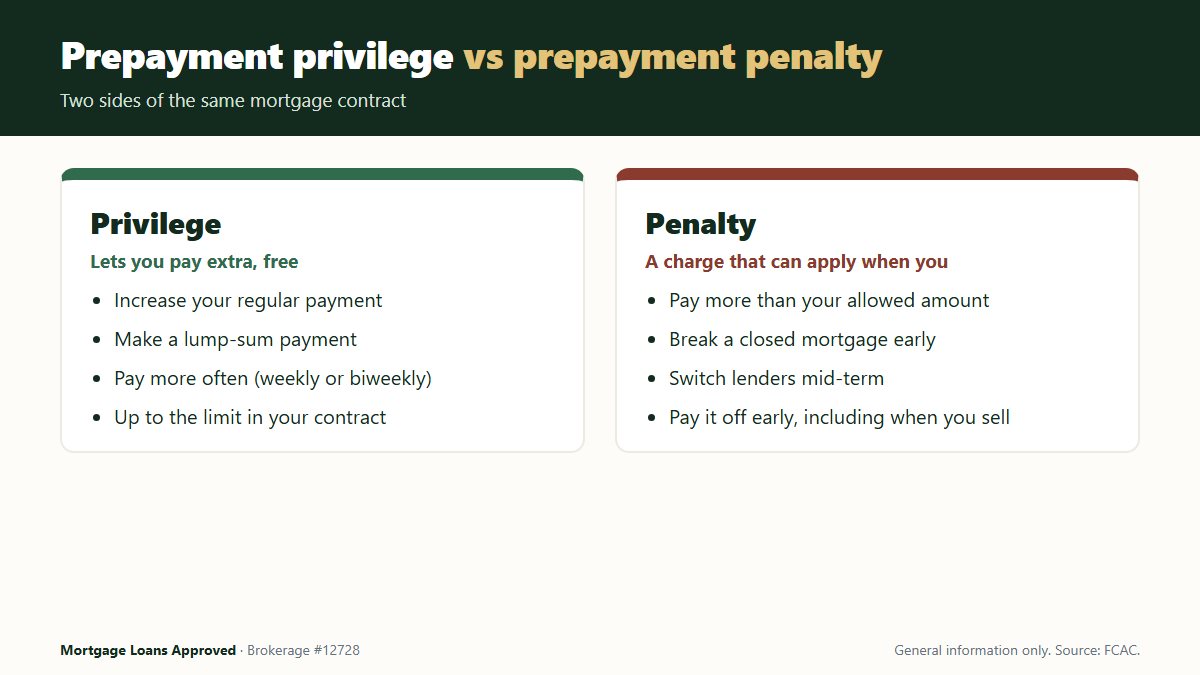
A mortgage prepayment privilege is a feature in your mortgage contract that lets you pay more than your scheduled mortgage payments without triggering a prepayment charge. Depending on the lender and mortgage contract, this may include increasing your regular payment, making a lump-sum payment, or using another permitted payment option.
Source: Financial Consumer Agency of Canada — Mortgage fees: Prepayment penalties
A prepayment penalty, also called a prepayment charge or breakage cost, is a fee a lender may charge when you pay more than your allowed amount, break your mortgage contract, transfer the mortgage to another lender before the end of the term, or pay off the mortgage early.
Source: Financial Consumer Agency of Canada — Mortgage prepayment: know your rights
Understanding both sides is important. Prepayment privileges can help you reduce your mortgage balance and interest costs, while penalties can make an early payoff, refinance or lender switch much more expensive than expected.
Why Mortgage Prepayment Privileges Matter
Paying extra toward your mortgage can reduce the principal balance faster. A lower balance generally means less interest is charged over time, although the exact savings depend on your interest rate, payment schedule, remaining amortization and the amount you prepay.
Source: Financial Consumer Agency of Canada — Paying off your mortgage faster
The important detail is that a closed mortgage normally limits how much you can prepay without a charge. Your contract determines the amount, timing and conditions of your prepayment privileges.
Common Types of Mortgage Prepayment Privileges
1. Increasing Your Regular Mortgage Payment
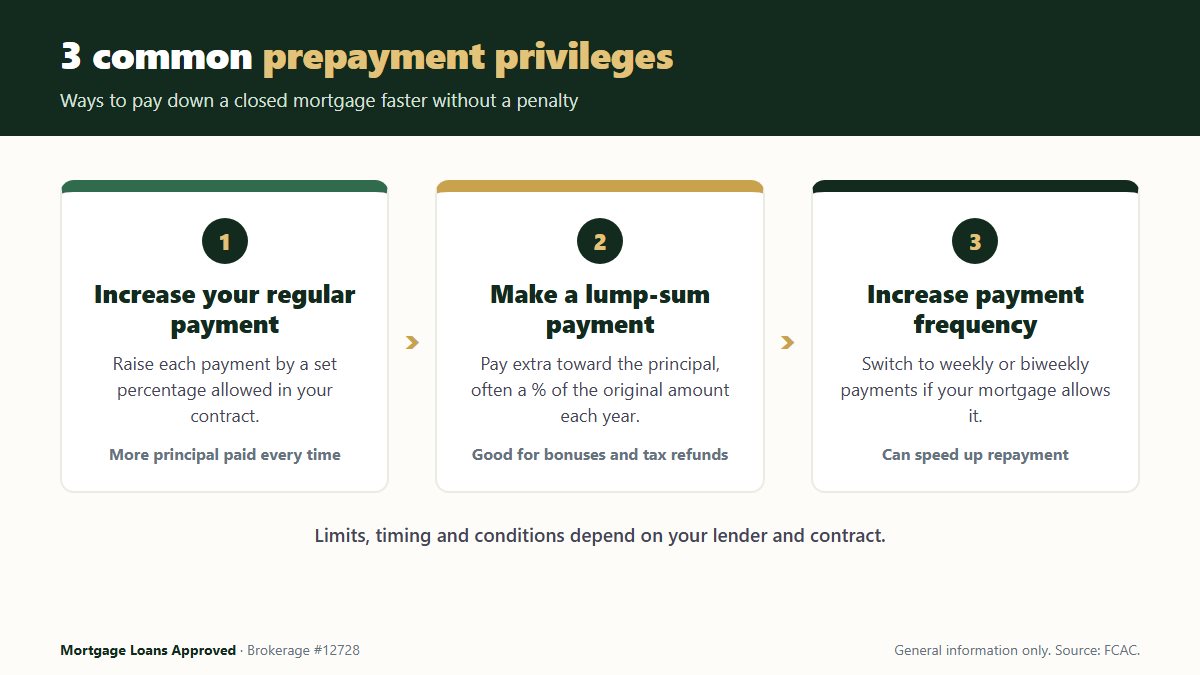
Some mortgage contracts allow you to increase your regular payment by a specified percentage without a penalty. This can help you pay down principal faster because more money is directed toward the mortgage on every payment date.
Source: Financial Consumer Agency of Canada — Paying off your mortgage faster
2. Lump-Sum Prepayments
A lump-sum privilege allows you to make an additional payment toward your mortgage principal without a prepayment charge, up to the amount permitted by your contract. For example, a contract might allow a specific percentage of the original mortgage amount each year.
Source: Financial Consumer Agency of Canada — Mortgage fees: Prepayment penalties
3. Increasing Payment Frequency
Some mortgage arrangements allow borrowers to switch to more frequent payment schedules, such as weekly or biweekly payments. Depending on the contract, increasing payment frequency can help accelerate repayment.
Source: Financial Consumer Agency of Canada — Code of Conduct for Mortgage Prepayment Information
Open vs. Closed Mortgages: Why It Matters
| Feature | Open Mortgage | Closed Mortgage |
|---|---|---|
| Extra payments | Generally more flexible | Limited by contract privileges |
| Breaking the mortgage | Generally can be done without a prepayment penalty | Usually may trigger a prepayment penalty |
| Interest rate | Typically higher than comparable closed mortgages | Typically lower than comparable open mortgages |
| Best fit | Borrowers who value flexibility | Borrowers who expect to keep the mortgage for the term |
Open mortgages generally provide more flexibility for paying down or ending the mortgage early, while closed mortgages usually have more restrictions but can offer lower interest rates than comparable open mortgages.
Source: Financial Consumer Agency of Canada — Choosing a mortgage that is right for you
When Can a Mortgage Prepayment Penalty Apply?
- Paying more than your annual or otherwise permitted prepayment amount.
- Breaking a closed mortgage before the end of its term.
- Transferring your mortgage to another lender before the term ends.
- Paying off the mortgage completely before the end of the term, including when selling the property.
- Refinancing in a way that requires the existing mortgage to be broken.
Source: Financial Consumer Agency of Canada — Mortgage prepayment: know your rights
How Are Mortgage Prepayment Penalties Calculated?
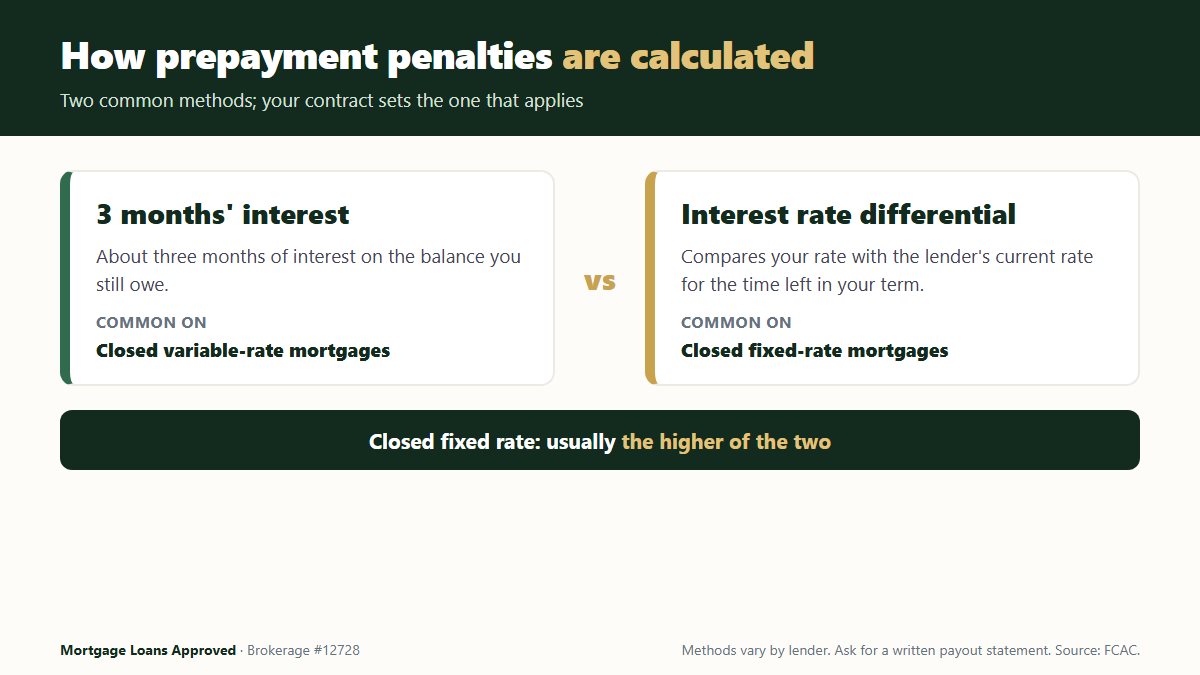
The exact calculation depends on your mortgage contract and lender. For many closed fixed-rate mortgages, the charge may be based on the greater of a specified number of months of interest or an Interest Rate Differential (IRD). However, you should not assume that every mortgage uses the same formula.
Source: Financial Consumer Agency of Canada — Mortgage fees: Prepayment penalties
Three Months' Interest
Some mortgage contracts use an amount equivalent to three months of interest as one possible component of the prepayment charge. The actual calculation depends on the terms of your mortgage. Many closed variable-rate mortgages charge three months' interest rather than an IRD; our guide to fixed vs variable mortgages compares the two.
Interest Rate Differential (IRD)
An IRD compares your mortgage rate with a relevant current rate used by the lender for the remaining portion of your term. The calculation can be more complicated than simply multiplying the difference between two rates by your mortgage balance, so the lender's contract and calculation method matter.
Source: Financial Consumer Agency of Canada — Mortgage fees: Prepayment penalties
Mortgage Penalty Example
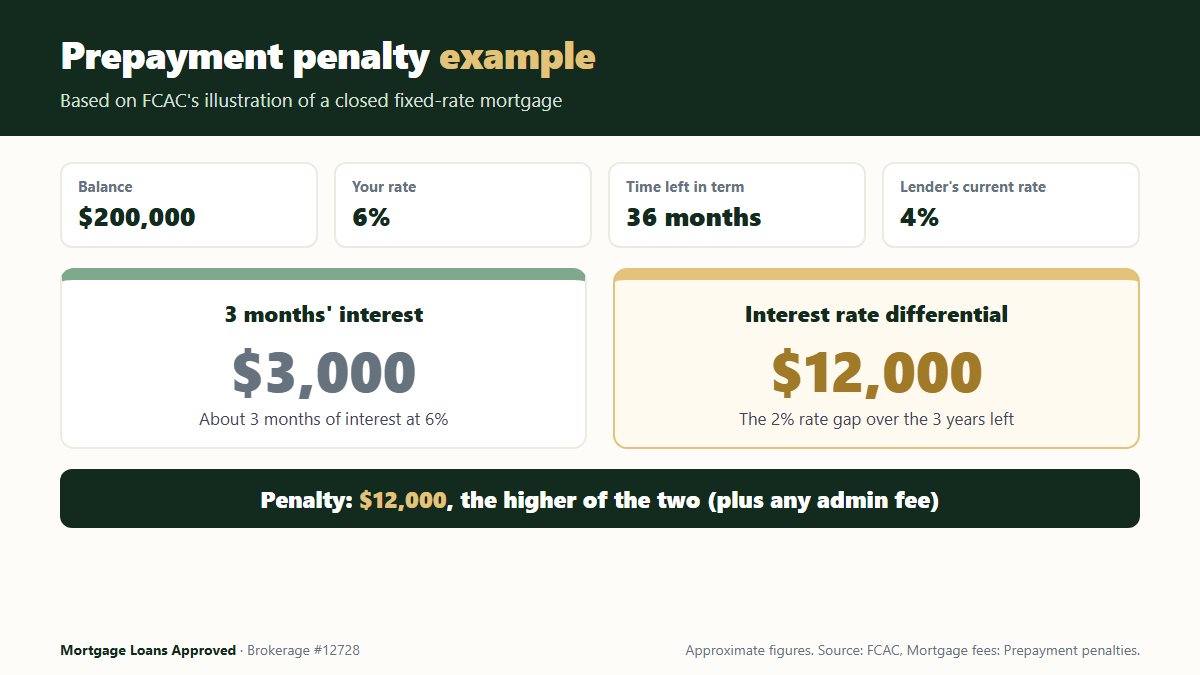
Suppose you have a $200,000 mortgage balance at 6%, with 36 months left in a 5-year term, and your lender's current posted rate for a 36-month term is 4%. FCAC's example works out approximately as follows:
- Three months' interest: about $3,000
- Interest rate differential: about $12,000, reflecting the 2% gap between 6% and 4% over the 3 years left
The prepayment penalty is $12,000, because it is the higher of the two amounts. FCAC notes you may also have to pay an administration fee.
Source: Financial Consumer Agency of Canada — Mortgage fees: Prepayment penalties
This is an illustration from FCAC, not a universal calculation for every mortgage. Your actual penalty can be different because lenders use the terms and calculation method set out in your mortgage contract.
Why Can an IRD Penalty Be So High?
The potential IRD can become significant when your existing mortgage rate is substantially higher than the relevant current rate and you have a large balance with considerable time remaining in the term. The exact amount depends on the lender's methodology and the terms of the mortgage.
This is why comparing a new mortgage rate with your existing rate is not enough. If you are thinking about refinancing or switching lenders before the end of your term, calculate the cost of breaking the existing mortgage as part of the decision.
If you are considering refinancing, review your mortgage refinance options and compare the potential savings with the cost of ending your existing mortgage.
Should You Use a Mortgage Penalty Calculator?
A mortgage penalty calculator can provide an estimate, but it should not replace a formal payout statement from your lender. The lender has the contract terms and information needed to calculate the actual charge applicable to your mortgage.
If your lender provides an online prepayment calculator, use it as an initial estimate and then request a written payout or prepayment statement when you are making a real decision.
You can also use the mortgage calculators available on Mortgage Loans Approved as part of your broader mortgage planning process.
How to Reduce or Avoid Mortgage Prepayment Penalties
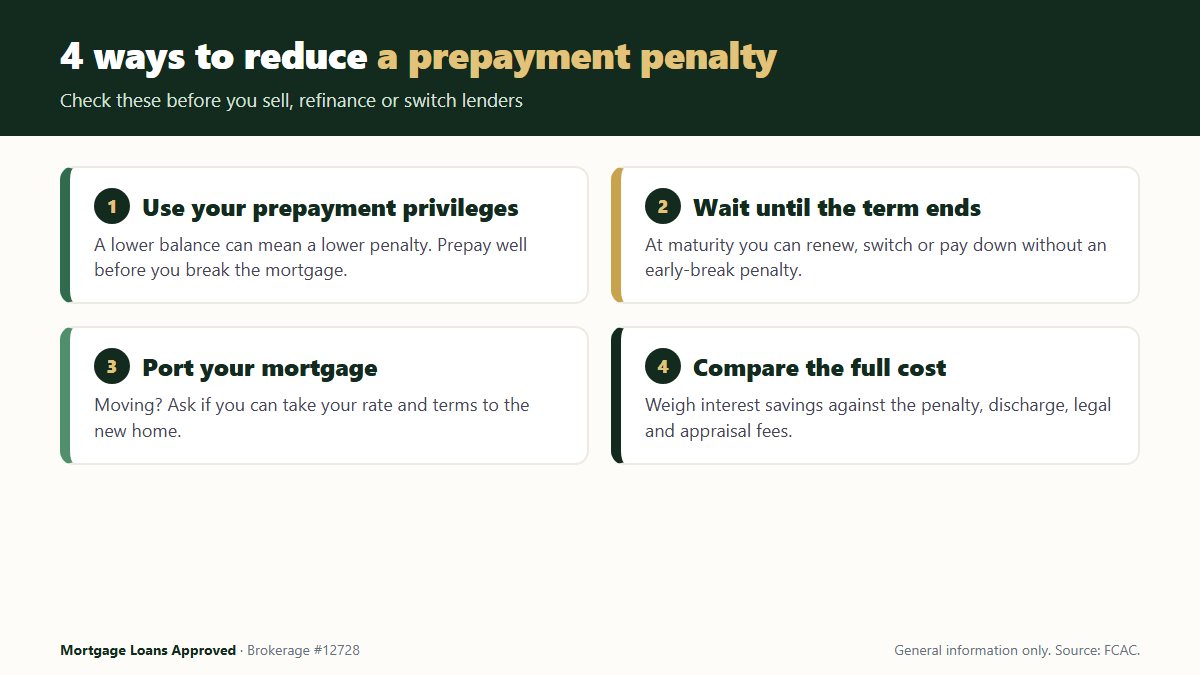
Use Your Annual Prepayment Privilege
If your mortgage allows annual lump-sum or payment-increase privileges, using them can reduce your principal before you decide to sell, refinance or switch lenders. A smaller balance may reduce the amount on which a future prepayment charge is calculated. Make the prepayment well ahead of time: FCAC notes that some lenders restrict prepayments when you are close to the date you break the contract.
Source: Financial Consumer Agency of Canada — Mortgage fees: Prepayment penalties
Wait Until the End of the Term
If you do not need to change your mortgage immediately, waiting until the end of the term can allow you to avoid a penalty that would otherwise apply to breaking the mortgage early.
Source: Financial Consumer Agency of Canada — Mortgage fees: Prepayment penalties
Consider Porting Your Mortgage
If you are selling your current home and buying another one, ask your lender whether your mortgage can be ported. Porting may allow you to take your existing mortgage terms to the new property and avoid breaking the original mortgage, subject to the lender's rules and your new purchase qualifying.
Source: Financial Consumer Agency of Canada — Mortgage fees: Prepayment penalties
Compare the Full Cost Before Refinancing
A lower interest rate does not automatically mean refinancing will save you money. Compare the interest savings with the prepayment penalty, discharge fees, legal or professional costs, appraisal costs and any other applicable charges.
Source: Financial Consumer Agency of Canada — Breaking your mortgage contract
What Should You Check in Your Mortgage Contract?
- How much can you prepay each year without a charge?
- Can you increase your regular payment, and by how much?
- Can you make lump-sum payments?
- When can lump-sum payments be made?
- Does the privilege reset annually?
- Can unused prepayment room be carried forward?
- How is the prepayment penalty calculated?
- Does the lender use an IRD calculation, and how is it defined?
- Are there administration, discharge or other fees?
- Can the mortgage be ported if you move?
For federally regulated financial institutions, mortgage agreements must disclose prepayment privileges, penalty charges and key information about how charges are calculated.
Source: Financial Consumer Agency of Canada — Getting a mortgage: know your rights
What Happens If You Sell Your Home Before the Mortgage Term Ends?
Selling your home does not automatically eliminate a mortgage prepayment charge. If you need to pay off a closed mortgage before the end of its term, the lender may charge a prepayment penalty, along with other applicable fees.
Source: Financial Consumer Agency of Canada — Mortgage prepayment: know your rights
Before listing your property, ask your lender for a current payout statement and find out whether your mortgage can be ported to another property. This lets you compare the cost of breaking the mortgage with the available alternatives.
What Happens at Mortgage Renewal?
At the end of your mortgage term, you generally have an opportunity to renew, switch lenders or make a larger payment without the same early-break penalty that would apply during the term. However, other transaction or discharge costs may still apply depending on the situation.
If you are approaching renewal, review your prepayment privileges and mortgage balance before deciding whether to pay down a lump sum, renew, switch lenders or refinance.
Planning ahead can make the decision easier. Our mortgage renewal checklist walks through what to review before your renewal date, and our mortgage renewal service can compare offers for you.
Who Should Pay Particular Attention to Prepayment Privileges?
- Homeowners who expect to receive bonuses or large lump sums.
- Borrowers who may sell their home before the mortgage term ends.
- Homeowners who expect to refinance before renewal.
- Borrowers who want to pay their mortgage off faster.
- People who may move for work or family reasons during the mortgage term.
- Borrowers comparing mortgages primarily on interest rate and not on flexibility.
Interest Rate Differential: What You Should Know
The Interest Rate Differential, commonly called IRD, is one of the most important concepts to understand if you have a closed fixed-rate mortgage and may break it early. An IRD-based charge can vary significantly depending on the mortgage balance, remaining term, your original rate and the rate used by the lender in its calculation.
Source: Financial Consumer Agency of Canada — Mortgage fees: Prepayment penalties
Because IRD calculations can differ by lender, do not rely on a generic online estimate when making a major financial decision. Ask your lender to explain the calculation and provide the amount applicable to your mortgage.
Common Mistakes to Avoid
- Assuming every lender offers the same prepayment privileges.
- Assuming every mortgage uses the same penalty formula.
- Looking only at the interest rate when choosing a mortgage.
- Breaking a mortgage without first requesting a current payout statement.
- Failing to ask whether the mortgage is portable.
- Not using available prepayment privileges before a potential mortgage break.
- Assuming a mortgage penalty calculator gives the final payout amount.
Final Thoughts
Mortgage prepayment privileges can be valuable because they give you a way to reduce your balance faster without paying a penalty. But the same mortgage can also impose a significant charge if you exceed the permitted amount or break the contract early.
Before making a lump-sum payment, refinancing, selling your home or switching lenders, check your mortgage contract and request the actual prepayment amount from your lender. A mortgage with a slightly different interest rate may be more suitable if it gives you the flexibility you expect to use.
If you want to compare your options, you can contact Mortgage Loans Approved to discuss your mortgage situation.
Talk to Mortgage Loans Approved today
Phone: 416-710-3239
Email: pkalsi@mortgageloansapproved.com
Office: 2120 Matheson Blvd East, Suite 201, Mississauga, ON L4W 5E1
Hours: Mon–Fri 9 am – 6 pm, evenings and weekends by appointment
Request a call back or explore all our mortgage solutions.
FAQs
Frequently asked questions
It is a contractual feature that lets you pay more than your regular mortgage payment without a prepayment charge, subject to the amount and conditions set by the lender.
It is a charge that may apply when you exceed your allowed prepayment amount, break a mortgage contract, transfer the mortgage before the term ends or pay the mortgage off early.
IRD stands for Interest Rate Differential. It is a method some lenders use to calculate a prepayment charge, particularly for closed fixed-rate mortgages. The exact formula depends on the mortgage contract and lender.
Depending on your situation, you may be able to use your prepayment privileges, wait until the end of the term, port the mortgage when moving, or choose a mortgage with greater flexibility. Always check your contract first.
Possibly. Many closed mortgages provide a lump-sum prepayment privilege, but the amount and timing vary by lender and contract.
Refinancing can require you to break your existing mortgage before the end of the term, which may result in a prepayment penalty and other costs.
No. Prepayment privileges vary by lender and mortgage contract. Compare the allowed lump-sum amount, payment increase, timing and other conditions.
Transferring before the end of the term may trigger a prepayment charge. Ask your lender about the cost and whether there are options such as porting or waiting until renewal.
Disclaimer: This article is for general information only and isn't financial or legal advice. Rates, fees and approvals depend on your situation and the lender. Mortgage Loans Approved is a mortgage brokerage operating under Mortgage Architects, FSRA Brokerage Licence #12728.

Founder & Principal Broker at Mortgage Loans Approved, specializing in first-time buyers and newcomers to Canada.