


Alternative mortgage lending is likely to remain part of Canada’s housing-finance landscape because borrowers do not all have the same income patterns, credit histories, property needs, or timing constraints. Banks and other traditional lenders apply underwriting criteria to assess whether a borrower can repay a loan. Some applicants may not fit those criteria at a particular moment, even when they have a clear reason for borrowing or a plan to improve their financial position. Alternative lenders can offer another route, but that route is not automatically cheaper, safer, or suitable for every borrower.
The strongest case for alternative lending is not that every borrower should use it. It is that Canada’s mortgage market includes different borrower profiles and different lending models, and responsible financing decisions require a transparent comparison of options, costs, risks, and a realistic repayment plan.
What the Latest CMHC Data Shows
A useful starting point is the Canada Mortgage and Housing Corporation (CMHC). Its Residential Mortgage Industry Report, Fall 2026 edition, tracks lending by chartered banks, credit unions, mortgage investment entities (MIEs) and other non-bank lenders. The picture is clear: the major banks still dominate, and alternative lending is a smaller, specialized segment, not a replacement for traditional lending.
CMHC also notes that MIEs, a type of private lender, accounted for only 1.8% of total outstanding mortgage balances in the first quarter of 2026, and that they show the strongest signs of lender-side stress. For borrowers, that is a reminder that the lender’s own strength and terms matter, not just whether it will say yes.
The picture looks different in Ontario. FSRA found that private lenders funded 15.8% of all Ontario residential mortgages in 2024, and 17.3% in the GTA, as we explain in our alternative mortgage lenders guide. That share is why Ontario’s regulator treats private mortgages as a supervisory priority.
Source: CMHC, Residential Mortgage Industry Report — Fall 2026
What Is Alternative Mortgage Lending?
“Alternative lending” is a broad market term rather than one single mortgage product. In Canada, it can refer to mortgages offered by lenders outside the major banks, including some credit unions, non-bank financial institutions, B-lenders, and private lenders. These categories are not identical: they can have different underwriting approaches, funding models, pricing, regulation, and product terms. A borrower should assess the specific lender and contract rather than assume that every alternative lender operates the same way.
B-lenders often consider applications that do not fit a bank’s standard criteria, while private lending tends to be more property- and equity-focused and is usually short-term. That flexibility can come with higher interest rates, fees, shorter terms, and greater refinancing risk. Our guide to alternative mortgage lenders in Canada explains each lender tier, how B-lenders qualify you and what the costs look like in practice.
Ontario’s Financial Services Regulatory Authority (FSRA) explains that consumers who cannot obtain a mortgage from a bank or credit union may consider alternative or private lenders, and that specific licensing requirements apply to mortgage professionals arranging these loans.
Source: FSRA, Mortgage Brokering: Consumer information
5 Reasons Alternative Lending Is Here to Stay
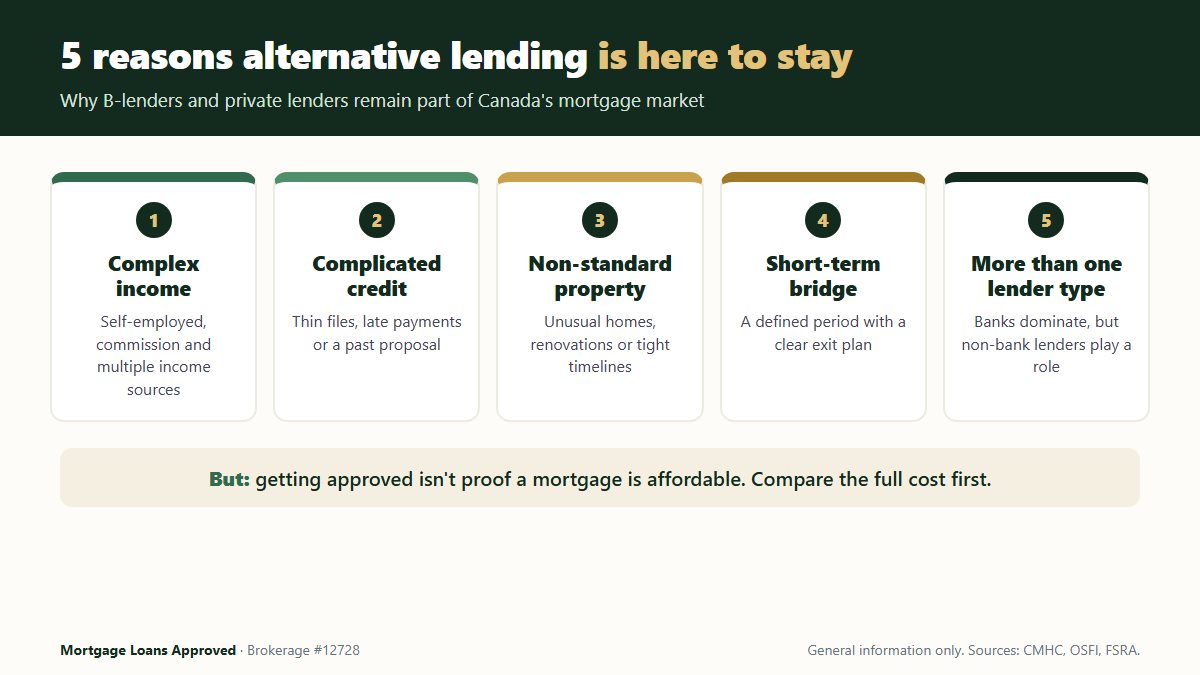
1. Borrowers’ income does not always fit standard models
Self-employed people, business owners, commission-based workers, contractors, and people with multiple income sources may have finances that are more complex than a standard employment-paystub model. A lender still needs to assess repayment capacity, but the documents and methods used to understand income can differ. Borrowers should never inflate or misrepresent income; instead, they should ask what records a lender accepts and whether a more suitable product is available. Our guide on how self-employed Canadians can qualify for a mortgage covers this in detail.
OSFI’s Guideline B-20 sets out prudent mortgage underwriting expectations for federally regulated financial institutions, including careful assessment of borrowers’ capacity to service debt and rigorous income verification. This helps explain why some applications require more documentation or may not fit a particular lender’s criteria. It does not mean that every declined application should move to alternative lending.
Source: OSFI, Residential Mortgage Underwriting Practices and Procedures — Guideline B-20
2. Credit history can be complicated
A borrower may have a thin credit file, past late payments, a consumer proposal history, or other credit challenges. Different lenders assess risk differently, but a more flexible assessment does not remove the need to make affordable payments. Before accepting a higher-cost mortgage, compare whether time spent rebuilding credit, reducing debts, documenting income, or increasing savings could open up a lower-cost option. See what credit score you need to buy a house in Canada.
3. Property and financing needs can be non-standard
Some properties, renovation situations, or time-sensitive transactions may not fit a lender’s standard product rules. Alternative financing may be considered where the property, borrower, or transaction requires a different approach. However, a property-based loan still needs a sustainable repayment plan; relying only on future appreciation or a hoped-for refinance can expose the borrower to risk.
4. Borrowers may need a temporary bridge to a longer-term solution
In some cases, alternative financing is used for a defined period, for example while a borrower completes a renovation, organizes financial documentation, resolves a short-term issue, or prepares to qualify for conventional financing. A short-term mortgage should have a credible exit strategy with milestones, timing, and a backup plan. “I will refinance later” is not enough unless the assumptions are realistic and can be revisited if circumstances change.
5. Canada’s mortgage market has more than one type of lender
CMHC’s reporting shows banks, credit unions, MIEs and other non-bank lenders all taking part in mortgage lending, with the major banks remaining by far the largest group. The practical takeaway is that borrowers may encounter different lender models, and the existence of more options makes comparison and disclosure more important, not less.
Alternative Lending Is Not a Shortcut Around Affordability
The ability to obtain financing does not prove that the loan is affordable. A mortgage that is expensive or difficult to renew can increase financial pressure, especially if the borrower expects to refinance after a short term. Before signing, calculate the payment, interest, fees, legal costs, renewal exposure, and likely cost of exiting the loan. Consider whether the plan still works if income falls, the property takes longer to sell, rates change, or refinancing is unavailable.

FSRA’s mortgage product suitability guidance says that, where a private mortgage is recommended, a mortgage broker or agent should be able to explain why it is needed, discuss affordability and the consequences of missed payments, and identify a feasible exit strategy. The guidance also addresses the risk that interest and other costs can consume home equity over time.
Source: FSRA, Mortgage Product Suitability Assessment
A mortgage contract is legally binding, and FSRA requires licensed mortgage professionals to disclose material risks in writing and in plain language before you sign. Read every document, ask questions, and do not rely on verbal assurances that are not in the contract. For a full list of costs, red flags and questions to ask, see the risks and red flags and exit strategy sections of our alternative lenders guide.
Conclusion: A Lasting Part of a Diverse Mortgage Market
Alternative lending is likely to remain relevant because Canadian borrowers have different income profiles, credit histories, property needs, and timelines. CMHC’s industry reporting documents the participation of non-bank lenders alongside the dominant role of the major banks. That diversity can create additional financing routes, but it also makes careful comparison essential.
The responsible question is not simply whether alternative lending is available. It is whether a specific mortgage is affordable, transparent, appropriate for the borrower’s needs, and supported by a realistic plan for repayment or exit. Borrowers should compare lower-cost alternatives where possible, understand every contract term, and seek advice from a properly licensed professional.
If the bank has said no, talk to Mortgage Loans Approved. Licensed mortgage broker Pritpal Singh Kalsi and the team compare options across 57+ lenders, including banks, credit unions, B-lenders and private lenders, and explain the full cost and exit plan before you commit.
Talk to Mortgage Loans Approved today
Phone: 416-710-3239
FAQs
Frequently asked questions
No. The major banks still hold most Canadian mortgages, and CMHC's reporting shows private lenders such as mortgage investment entities make up only a small share. Alternative lending serves certain borrower profiles and financing needs; it is better understood as one part of a wider market.
No. Borrowers may consider private financing for several reasons, including timing or property-related needs. However, the reason for using it should be clear, and affordability and exit planning are essential.
It is a realistic plan to repay, refinance, or otherwise leave a short-term mortgage. It should include specific steps, timing, affordability checks, and a backup if the expected refinance or sale does not happen.
Use FSRA's official consumer information and licensing resources, and ask the professional to explain their role, compensation, lender access, and the risks of the recommended mortgage.
Disclaimer: This article is for general information only and isn't financial or legal advice. Rates, fees and approvals depend on your situation and the lender. Mortgage Loans Approved is a mortgage brokerage operating under Mortgage Architects, FSRA Brokerage Licence #12728.

Founder & Principal Broker at Mortgage Loans Approved, specializing in first-time buyers and newcomers to Canada.