


What Is a Second Mortgage?
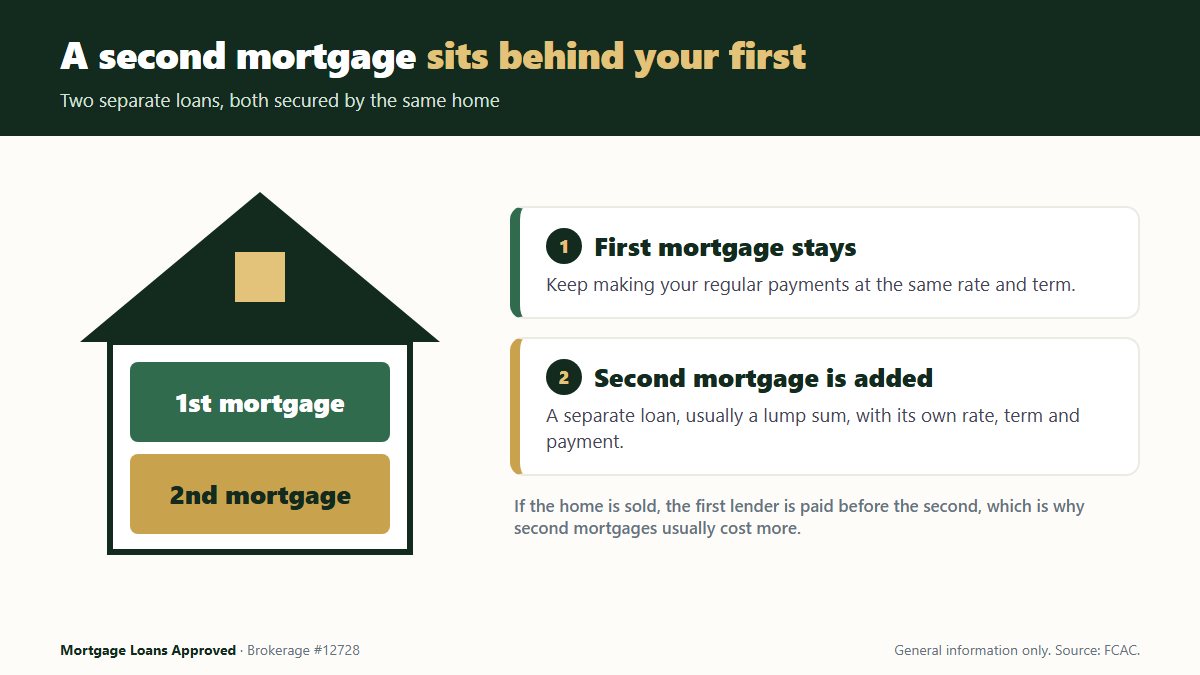
A second mortgage is an additional loan secured against a property that already has a first mortgage. The first mortgage remains in place, and the second mortgage is registered behind it. You continue making payments on your original mortgage while also meeting the repayment requirements of the second mortgage.
For example, imagine your home is worth $700,000 and you still owe $400,000 on your first mortgage. Your home has approximately $300,000 in equity before considering other secured debts and transaction costs.
Depending on the lender, your financial situation and the property’s value, some of that equity may potentially be used to secure additional financing.
The important point is that home equity is not the same thing as cash available to borrow. Lenders consider the property’s value, existing mortgage balance, other secured debts, your ability to repay, and their own lending criteria.
Source: Financial Consumer Agency of Canada (FCAC) — Borrowing Against Home Equity
How Does a Second Mortgage Work?
A second mortgage works alongside your existing first mortgage.
Think of the property as having two registered loans:
- First Mortgage → First position
- Second Mortgage → Second position
The first lender has priority over the second lender if the property is sold or enforcement proceedings occur. That difference in priority is one of the main reasons a second mortgage generally costs more than a first mortgage.
Source: FCAC — Borrowing Against Home Equity
Simple Example
- Home value: $700,000
- Existing first mortgage: $400,000
- Approximate equity: $300,000
A lender may consider the available equity when assessing a second mortgage. However, this does not mean you automatically qualify for $300,000. The lender may consider current property value, existing mortgage balance, other secured debts, loan-to-value ratio, credit history, income and affordability, property type and location, purpose of the funds, repayment plan and its own risk requirements.
Why Would Someone Consider a Second Mortgage?
1. Debt Consolidation
A homeowner may have several higher-interest debts, such as credit cards or other loans. Depending on the numbers, using home equity to consolidate debt may be considered as part of a broader debt-management strategy.
However, converting unsecured debt into debt secured against your home changes the risk. If you fail to meet the new mortgage obligations, your home may be at risk. Our debt consolidation page explains how lenders structure it.
2. Accessing Home Equity
Homeowners sometimes need access to a substantial amount of capital for a specific financial need. A second mortgage can provide a lump-sum amount secured against the property.
Source: FCAC — Borrowing Against Home Equity
3. Keeping a Low-Rate First Mortgage
A homeowner may have a favourable rate on an existing first mortgage but need additional funds. Breaking and refinancing that first mortgage could potentially involve a prepayment penalty, legal and appraisal costs, a different interest rate and other refinancing costs.
In some circumstances, a second mortgage may allow the homeowner to leave the existing first mortgage in place while accessing additional equity. The numbers need to be compared carefully rather than assuming a second mortgage is automatically cheaper.
4. When a Traditional Lender Says No
Some homeowners may not qualify for traditional mortgage financing because of credit challenges, irregular income, self-employment, recent financial problems, high debt levels or time-sensitive financing needs.
Alternative and private lenders may assess the property and overall situation differently.
Source: FSRA — Private Mortgages
How Much Can You Borrow With a Second Mortgage?
There is no single second-mortgage amount that applies to every homeowner. One important starting point is the property’s available equity.
FCAC’s general home-equity guidance says homeowners may usually borrow up to 80% of the home’s value against home equity, subject to the applicable product and lender requirements. Private lenders set their own limits; our private mortgage LTV guide explains how they use loan-to-value.
Illustrative example:
- Home value: $700,000
- 80% of home value: $560,000
- Existing mortgage: $400,000
- Illustrative remaining room: $560,000 − $400,000 = $160,000
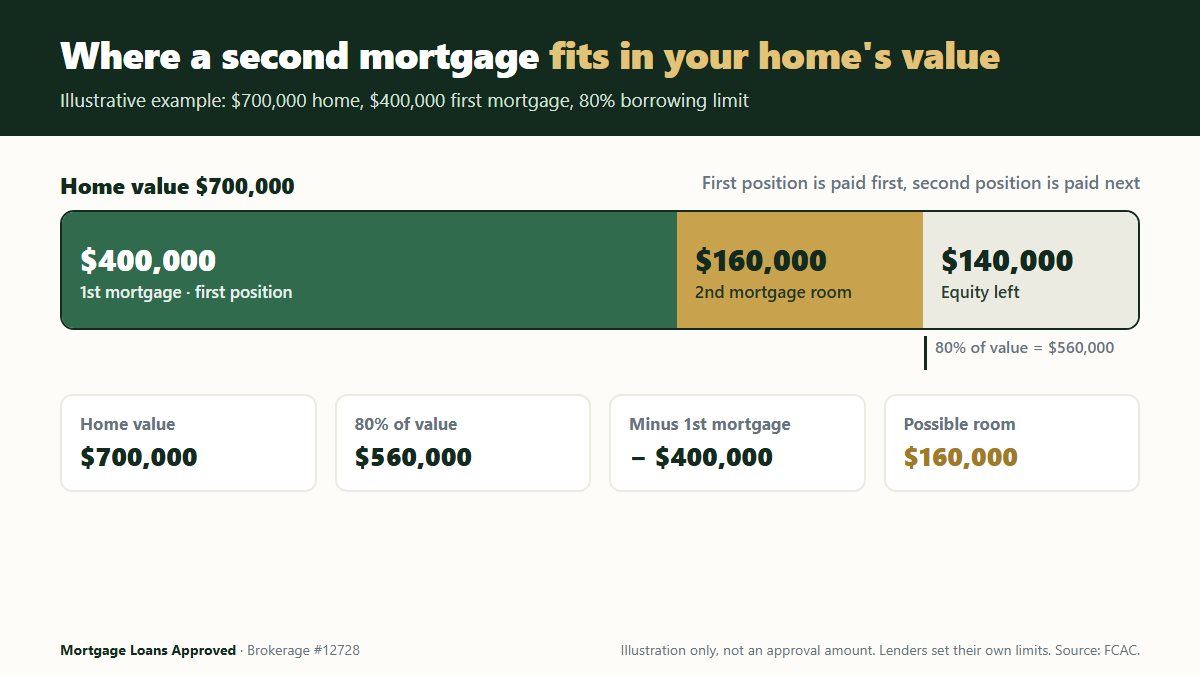
This is not a guarantee that a lender will approve $160,000. The actual amount can be lower depending on the lender, property, borrower and existing secured debt.
Source: FCAC — Borrowing Against Home Equity
Second Mortgage vs. HELOC
| Feature | Second Mortgage | HELOC |
|---|---|---|
| Access to funds | Usually lump sum | Revolving credit |
| Existing first mortgage | Usually remains | Usually remains |
| Interest rate | Generally higher than first mortgage | Usually variable |
| Repayment | Defined according to agreement | Revolving borrowing with required payments |
| Flexibility | Lower | Higher |
| Best suited for | Defined funding requirement | Ongoing or flexible access to equity |
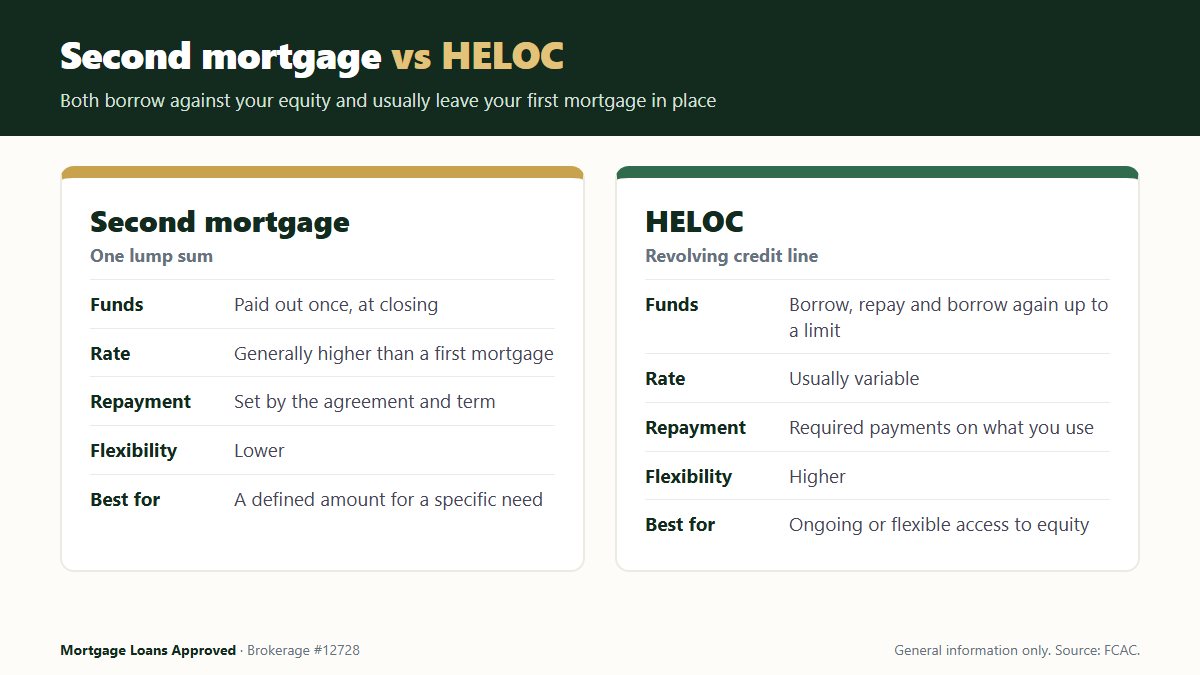
FCAC distinguishes second mortgages from HELOCs: a second mortgage generally provides a lump sum, while a HELOC provides revolving access to funds up to a credit limit. For a detailed cost comparison, see our guide to HELOC vs second mortgage in Ontario.
Source: FCAC — Borrowing Against Home Equity
Second Mortgage vs. Refinancing
Second Mortgage
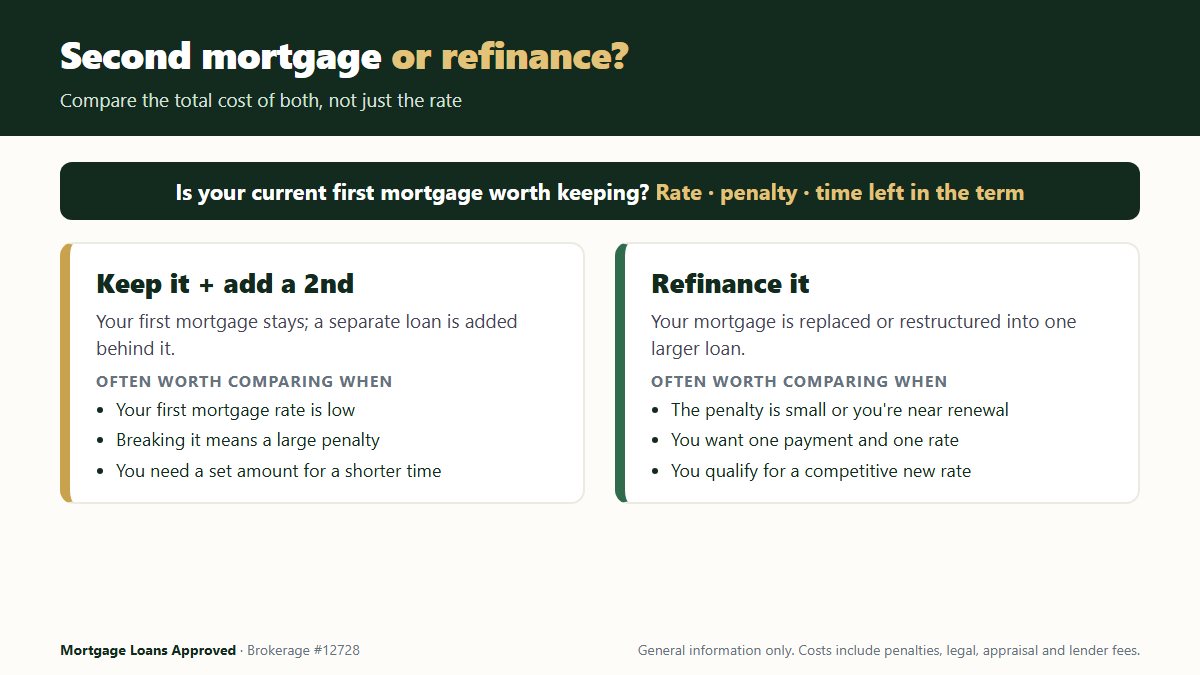
You generally keep your existing first mortgage and add another loan behind it.
Refinancing
You replace or restructure existing mortgage financing to access additional funds.
The right choice depends on your current mortgage rate, remaining mortgage balance, prepayment penalty, amount required, available equity, income, credit profile, new mortgage rate, closing costs and long-term repayment plan. If you are comparing the options, review mortgage refinancing options and use mortgage calculators to compare the numbers.
How Much Does a Second Mortgage Cost?
The cost is more than simply the interest rate.
Potential costs can include:
- Interest
- Lender fees
- Broker fees, where applicable
- Appraisal
- Legal fees
- Title-related costs
- Administration fees
- Potential discharge or renewal costs depending on the agreement
FCAC notes that home-equity borrowing can involve appraisal, title search, title insurance and legal fees.
Source: FCAC — Borrowing Against Home Equity
For private or alternative second mortgages, costs can be significantly different from traditional mortgage financing. FSRA warns consumers that alternative/private mortgages may have higher rates and fees and can include shorter terms and interest-only structures.
Source: FSRA — Private Mortgages
Don’t Compare Only the Rate
A better question is:
What will this financing cost me from start to finish?
A mortgage with a lower advertised rate isn’t necessarily cheaper once all fees, penalties and repayment conditions are included.
Are Second Mortgage Rates Higher?
Generally, yes.
The reason is risk. A second lender is behind the first mortgage in priority. If something goes wrong and the property has to be sold, the first mortgage is generally paid before the second mortgage.
Because the second lender takes greater risk, the interest rate is generally higher.
The actual rate can vary significantly depending on loan-to-value, property value, location, credit, income, loan purpose, lender, term and overall risk.
Source: FCAC — Borrowing Against Home Equity
Can You Get a Second Mortgage With Bad Credit?
Potentially, but approval isn’t guaranteed. Private and alternative lenders may place more emphasis on the property’s value and available equity than a traditional lender would.
However, bad credit does not make an expensive mortgage automatically affordable.
Before signing, understand:
- The interest rate
- All fees
- Payment requirements
- Term length
- Renewal conditions
- Prepayment rules
- What happens if payments are missed
- The plan for repaying or refinancing
Source: FSRA — Private Mortgages
When Might a Second Mortgage Make Sense?
A second mortgage may be worth considering when there is a clear financial reason and a realistic repayment plan.
Common examples include:
- Accessing equity without replacing a favourable first mortgage.
- Consolidating expensive debt when there is sufficient equity and a clear plan to avoid rebuilding the debt.
- Short-term financing when there is a specific need and another source of repayment is reasonably expected.
- Time-sensitive circumstances where traditional financing may take too long.
- Credit recovery when alternative financing is being used temporarily while working toward lower-cost financing.
- Investment or business financing, subject to the lender’s criteria.
When Might a Second Mortgage NOT Make Sense?
A second mortgage may be inappropriate if:
- You don’t know how you will repay it.
- The monthly payment is already difficult to afford.
- You’re using it to repeatedly cover ongoing spending.
- You are borrowing simply to delay an unavoidable financial problem.
- The fees make the total cost unreasonable.
- You are relying on future property appreciation to make the numbers work.
- You don’t understand the mortgage agreement.
- You have no realistic plan when the term ends.
Source: FSRA — Private Mortgages
What Is the Risk of a Second Mortgage?
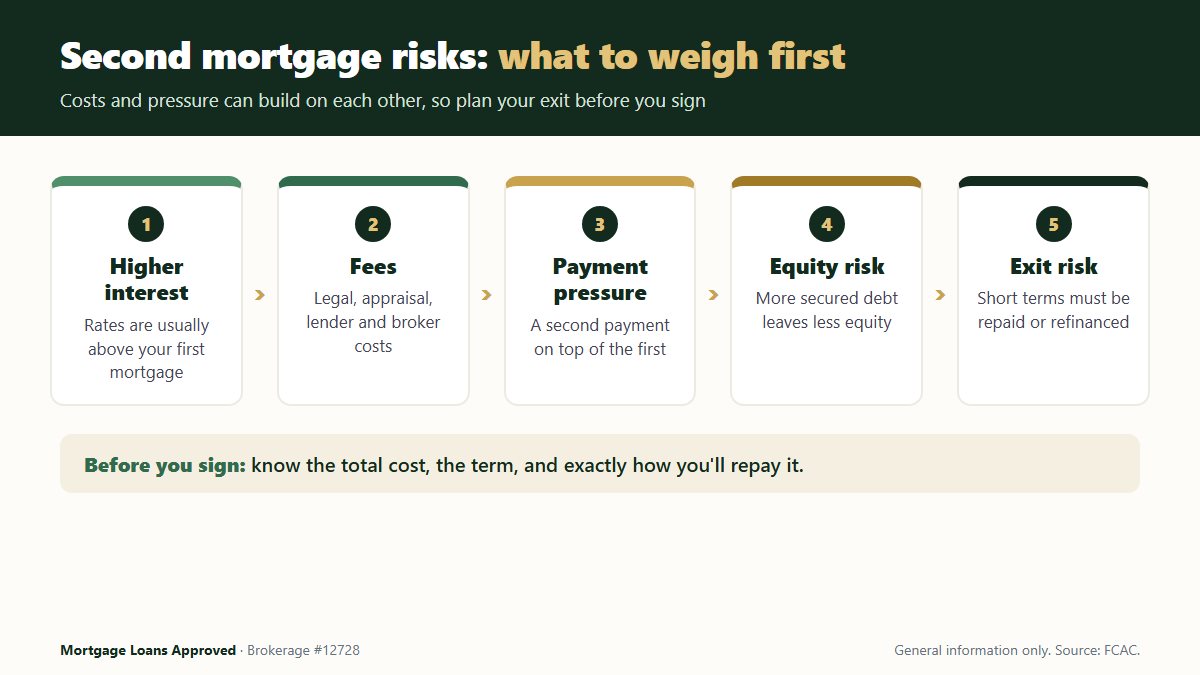
Higher borrowing costs
The second mortgage may have a substantially higher rate than the first.
Additional fees
Legal, appraisal, lender and broker costs can increase the total cost.
Equity erosion
If the property doesn’t appreciate while your secured debt increases, your available equity can shrink.
Payment pressure
You now have another financial obligation on top of the first mortgage. If payments fall behind, the lender can take enforcement steps; see what is power of sale in Ontario.
Refinancing risk
If the second mortgage has a short term, you need to know how you will repay or refinance it when it matures.
Source: FCAC — Borrowing Against Home Equity
First Mortgage vs. Second Mortgage: What’s the Difference?
| Feature | First Mortgage | Second Mortgage |
|---|---|---|
| Position | First | Second |
| Priority | Paid first | Paid after first mortgage |
| Existing mortgage | Creates primary mortgage | Added behind existing mortgage |
| Interest rate | Generally lower | Generally higher |
| Risk to lender | Lower | Higher |
| Access to equity | Can be part of original financing/refinance | Uses additional available equity |
| Common purpose | Purchase/refinance | Equity access, consolidation or specific financing need |
The key concept isn’t that one is automatically good and the other bad. It is about cost, risk, purpose and repayment strategy.
What Documents Might You Need?
A lender or mortgage professional may ask for:
- Government-issued identification
- Current mortgage statement
- Property tax information
- Property details
- Proof of income, where applicable
- Credit information
- Details of other debts
- Appraisal or property valuation
- Explanation of how funds will be used
- Proposed repayment or exit strategy
The exact documentation depends on the lender and the circumstances.
Source: FSRA — Working With a Mortgage Professional
How to Apply for a Second Mortgage
- Determine your equity. Establish your home’s current value and subtract the mortgage and other secured debts.
- Determine how much you actually need. Don’t automatically borrow the maximum amount available.
- Review your existing mortgage. Check your current rate, balance, maturity date and any applicable penalties.
- Compare financing options. Consider a second mortgage, HELOC, refinance, alternative mortgage and private mortgage.
- Calculate the total cost. Include interest, fees, legal costs, appraisal and other charges.
- Establish your repayment strategy. Ask how you will repay the loan and what happens when the term ends.
- Review the agreement carefully. Understand the rate, payment schedule, term, fees, renewal provisions, prepayment conditions and consequences of missed payments.
- Get professional advice. In Ontario, work with a properly licensed mortgage professional when using a mortgage brokerage.
Source: FSRA — Working With a Mortgage Professional
Second Mortgage Example
Illustrative example:
- Home value: $700,000
- First mortgage: $400,000
- Approximate equity: $300,000
- Additional financing need: $75,000
The homeowner could investigate whether a second mortgage, HELOC, refinance or another financing option is appropriate.
The important calculation isn’t simply, “Can I borrow $75,000?”
It is:
“What will borrowing $75,000 actually cost me, and how will I repay it?”
Questions to Ask Before Taking a Second Mortgage
- What is the interest rate?
- Is the rate fixed or variable?
- What are all the lender fees?
- Are there broker fees?
- What will the legal and appraisal costs be?
- What is the total amount I will repay?
- What is the mortgage term?
- Is there a minimum interest period?
- Can I make additional payments?
- Is there a prepayment penalty?
- What happens if I miss a payment?
- What happens when the mortgage term ends?
- Can I realistically refinance into a lower-cost mortgage?
- What is my backup plan if refinancing doesn’t happen?
Source: FSRA — Private Mortgages
Final Thoughts
A second mortgage can give a homeowner access to equity without necessarily replacing an existing first mortgage.
But the most important question isn’t, “How much equity do I have?”
It’s:
“Does this financing solve a specific problem at a cost I can realistically afford?”
Before choosing a second mortgage, compare it with a refinance, HELOC and other available options. Understand the complete cost, read the mortgage agreement carefully and have a clear repayment plan. Request a call back if you want to discuss your options with a mortgage professional, or see our 1st and 2nd mortgage service.
For homeowners considering a private second mortgage, an exit strategy should be part of the decision from the beginning, not something considered when the mortgage is about to mature.
Source: FSRA — Private Mortgages
https://www.fsrao.ca/privatemortgage
Talk to Mortgage Loans Approved today
Phone: 416-710-3239
Email: pkalsi@mortgageloansapproved.com
Office: 2120 Matheson Blvd East, Suite 201, Mississauga, ON L4W 5E1
Hours: Mon–Fri 9 am – 6 pm, evenings and weekends by appointment
Request a call back or explore all our mortgage solutions.
FAQs
Frequently asked questions
It can be appropriate in some situations, but it isn’t automatically the right choice. The cost, available equity, purpose of borrowing, payment affordability and repayment plan should all be considered.
No. A second mortgage generally provides a lump sum secured against your property, while a HELOC is a revolving line of credit.
It may be possible, depending on the lender and your financial situation. Homeowners should compare the total cost and understand that the consolidated debt becomes secured against the property.
Second mortgages are available in Ontario, subject to lender requirements and applicable rules. If you work through a mortgage brokerage, verify that the brokerage and mortgage professional are appropriately licensed with FSRA.
Because the loan is secured against your property, missed payments can have serious consequences. The exact enforcement process depends on the mortgage agreement and applicable law. Obtain professional legal advice if you’re already having difficulty making payments.
Disclaimer: This article is for general information only and isn't financial or legal advice. Rates, fees and approvals depend on your situation and the lender. Mortgage Loans Approved is a mortgage brokerage operating under Mortgage Architects, FSRA Brokerage Licence #12728.

Founder & Principal Broker at Mortgage Loans Approved, specializing in first-time buyers and newcomers to Canada.