

A Non-QM (non-qualified mortgage) is a term commonly used in the United States for mortgages that do not fit certain standard qualified-mortgage criteria. In Canada, borrowers and brokers more commonly talk about alternative mortgages, B-lender mortgages, or private mortgages. These labels are not interchangeable, and there is no single Canadian mortgage product that maps perfectly to the US Non-QM category.
In Canada, an alternative mortgage generally means financing for a borrower whose application does not fit a prime lender’s standard rules. A bank may be uncomfortable with how income is documented, a recent credit issue, the property, or the overall application. Another lender may assess the same file using different policies and evidence. That flexibility can help, but it usually comes with a higher total cost or additional conditions.
Source: FSRA — Private mortgages, FCAC — Getting preapproved for a mortgage
Non-QM vs. Alternative Mortgage: What Is the Difference?
The main difference is the market and terminology. In the United States, a “qualified mortgage” is one that meets federal ability-to-repay and qualified-mortgage rules, and Non-QM loans are the ones that fall outside that category. Canada has no QM category. Here, qualification is governed by each lender’s policies, the federal stress test and OSFI’s Guideline B-20 for federally regulated lenders, mortgage insurer rules for insured mortgages, and provincial rules for credit unions and mortgage brokering. A Canadian borrower should not assume that a US Non-QM label describes a specific product available here.
For a Canadian application, the practical question is usually whether a prime lender, alternative institutional lender, or private lender is best placed to assess the borrower’s income, credit history, debts, down payment or equity, and property. The exact product name matters less than the contract terms, qualification requirements, total costs, and realistic repayment plan.
US Non-QM Loan Types and Their Closest Canadian Equivalents
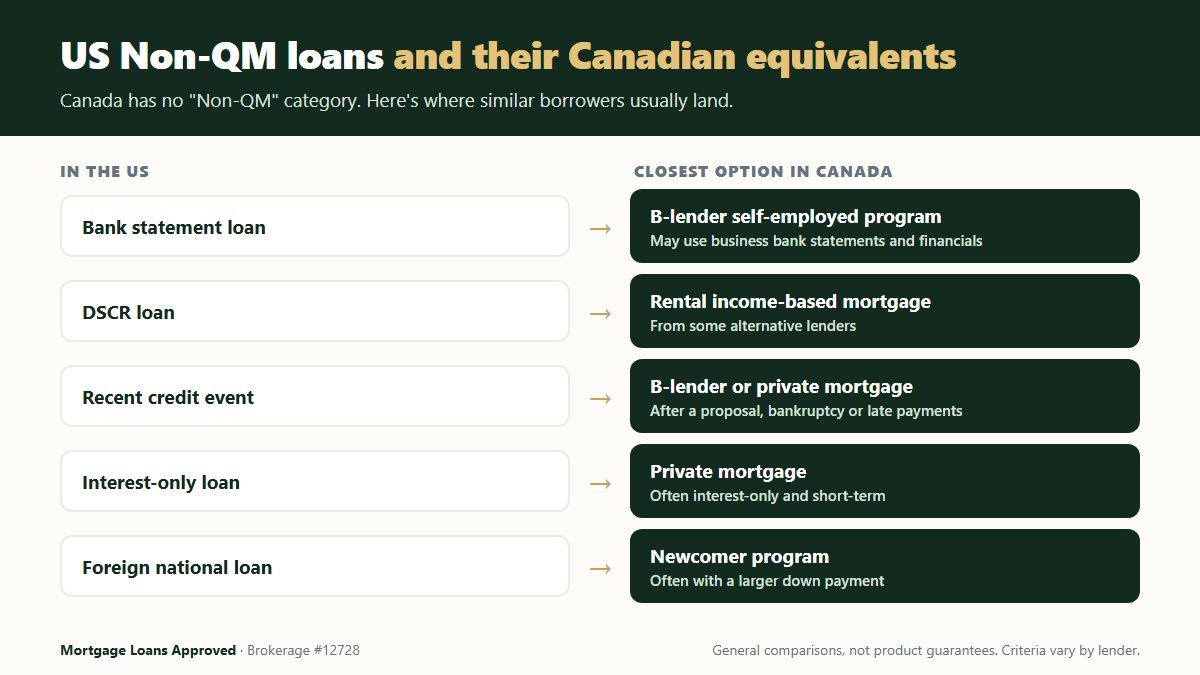
If you have read about Non-QM loans on US websites, this table shows where similar situations usually land in Canada. These are general comparisons, not product guarantees; programs and criteria vary by lender.
| US Non-QM loan | Closest option in Canada | Learn more |
|---|---|---|
| Bank statement loan (self-employed) | B-lender self-employed programs that may use business bank statements and financial statements alongside other documents | Self-employed mortgages |
| DSCR loan (rental property) | Rental mortgages from some alternative lenders that qualify mainly on the property’s rental income | DSCR mortgages in Canada |
| Recent credit event | B-lender mortgages after a consumer proposal, bankruptcy or late payments; private lending when the file is very recent | Credit score you need |
| Interest-only loan | Common in private mortgages, which are usually short-term | Private vs traditional mortgages |
| Foreign national or limited credit history | Newcomer programs at some prime and alternative lenders, often with a larger down payment | Home purchase options |
The Three Main Lender Channels in Canada
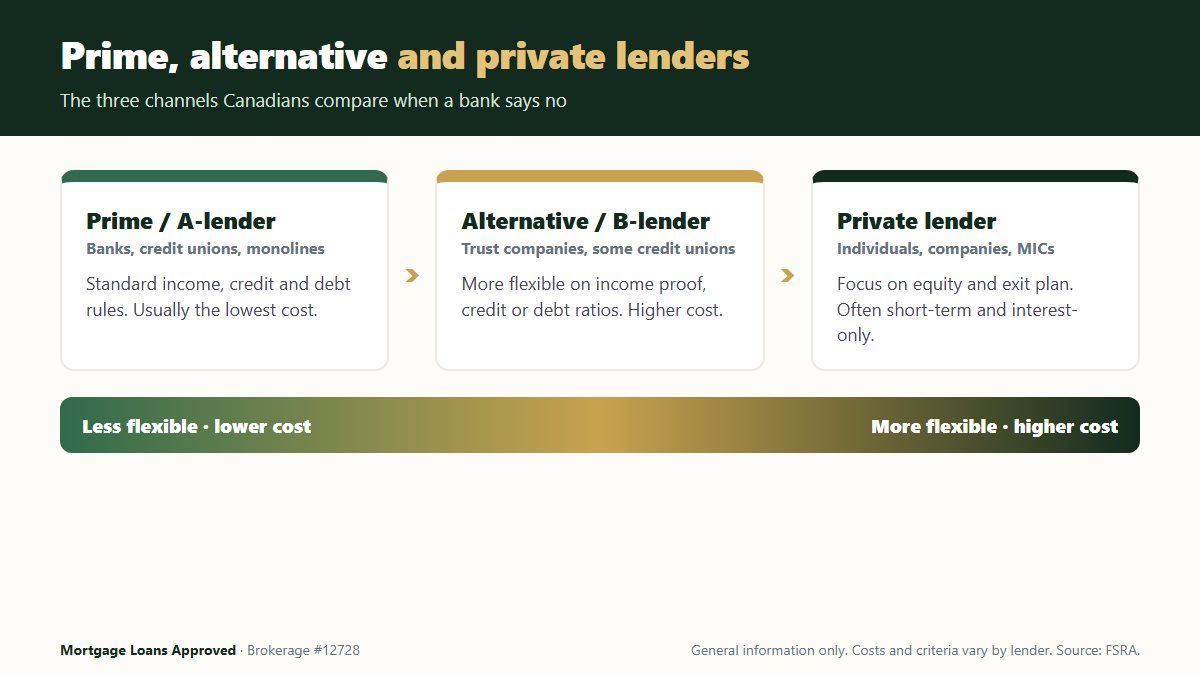
Prime or A-lender mortgages from banks, credit unions and other mainstream lenders are usually the lowest-cost option when you meet their credit, income, debt-service, down-payment and property requirements. Check whether this channel is realistically available before accepting a more expensive option.
Alternative or B-lender mortgages may consider applications that fall outside a prime lender’s policies, such as self-employed income documentation, credit history or debt ratios. “Alternative” does not mean automatic approval or a relaxed assessment of repayment ability, and these mortgages can involve higher rates, fees, stricter conditions or shorter terms.
Private mortgages may be funded by an individual, a private company, or a mortgage investment corporation (MIC). Private lenders may place greater emphasis on property value and available equity. Ontario’s financial regulator warns that private mortgages can have higher interest rates and fees, shorter terms, and interest-only payments, which do not reduce the principal. A private mortgage is often intended as a temporary solution, so an achievable exit plan is essential.
For a deeper look at each tier, how B-lenders qualify you and a worked cost example, see our guide to alternative mortgage lenders in Canada.
Source: FSRA — Private mortgages, FCAC — Choosing a financial institution
Who Uses an Alternative Mortgage in Canada?
Alternative financing may be relevant for borrowers with a sound overall plan whose application does not fit a particular lender’s standard criteria. It is not a shortcut around affordability; the lender will still assess the risk using its own requirements. Common situations include:
- Self-employed borrowers and business owners whose taxable income looks lower than the cash flow available to support a mortgage. All application information must still be accurate and verifiable; “stated income” never means income can be invented.
- Borrowers with recent credit challenges, such as missed payments or a consumer proposal, where approval and pricing depend on the full application, not just one score.
- People with non-standard income, including contractors, commission-based and seasonal workers, and newcomers with limited Canadian credit history.
- Borrowers with high debt ratios or complex applications that exceed a prime lender’s limits.
- Property owners who need short-term financing for a time-sensitive purchase, refinance or debt restructuring, with a realistic next step.
What Does an Alternative Mortgage Cost?
There is no single rate or fee schedule for alternative mortgages. Costs depend on the lender, province, borrower, property, loan-to-value ratio, term, and perceived risk. Rather than relying on a broad advertised range, request a written breakdown for the exact offer and compare it with other available offers.
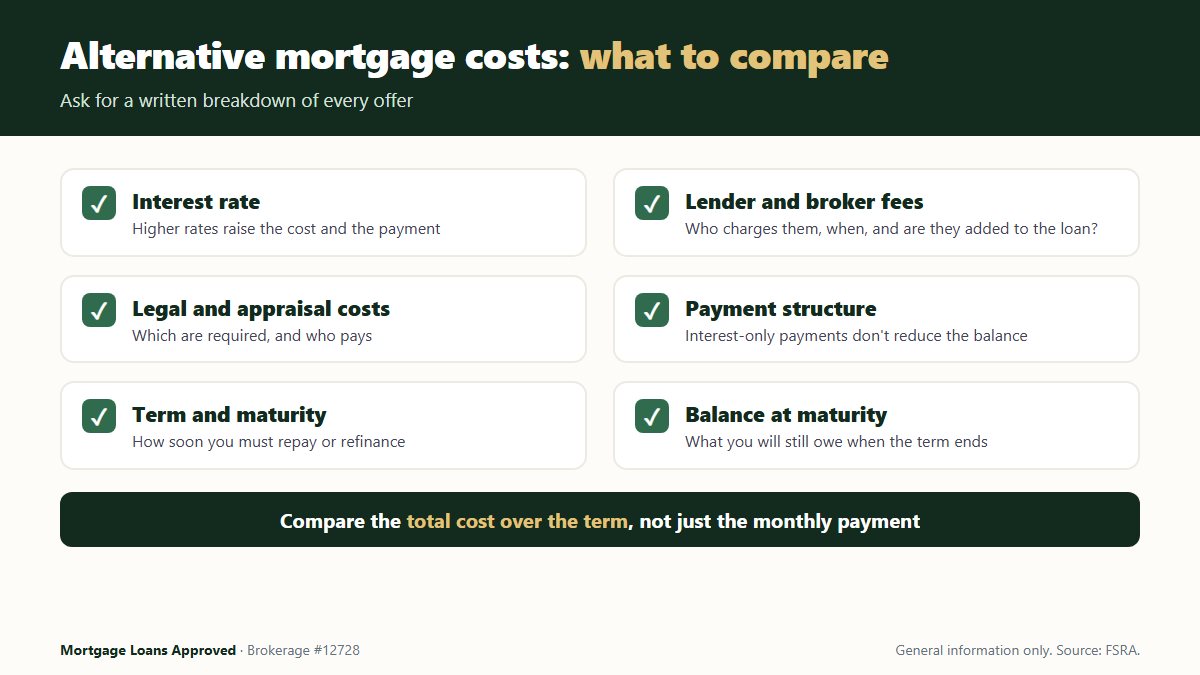
The most useful comparison is the total amount you will pay over the term and the amount still owing at maturity, not only the monthly payment or headline interest rate. If fees are added to the loan, the amount owed can increase even though you receive less cash.
Risks and Your Exit Plan
- Higher borrowing costs may consume equity or leave less money for other expenses.
- A short term can create refinancing pressure if your income or credit does not improve as expected.
- Interest-only payments leave the principal unchanged unless separate payments reduce it.
- Missed payments can have serious consequences, including enforcement against the property.
- Unlicensed or unsuitable providers add risk. Check the professional’s licence with your provincial regulator.
Before you sign, map out what must change before the term ends, how you will prove it, and what you will do if the expected refinance or sale does not happen.
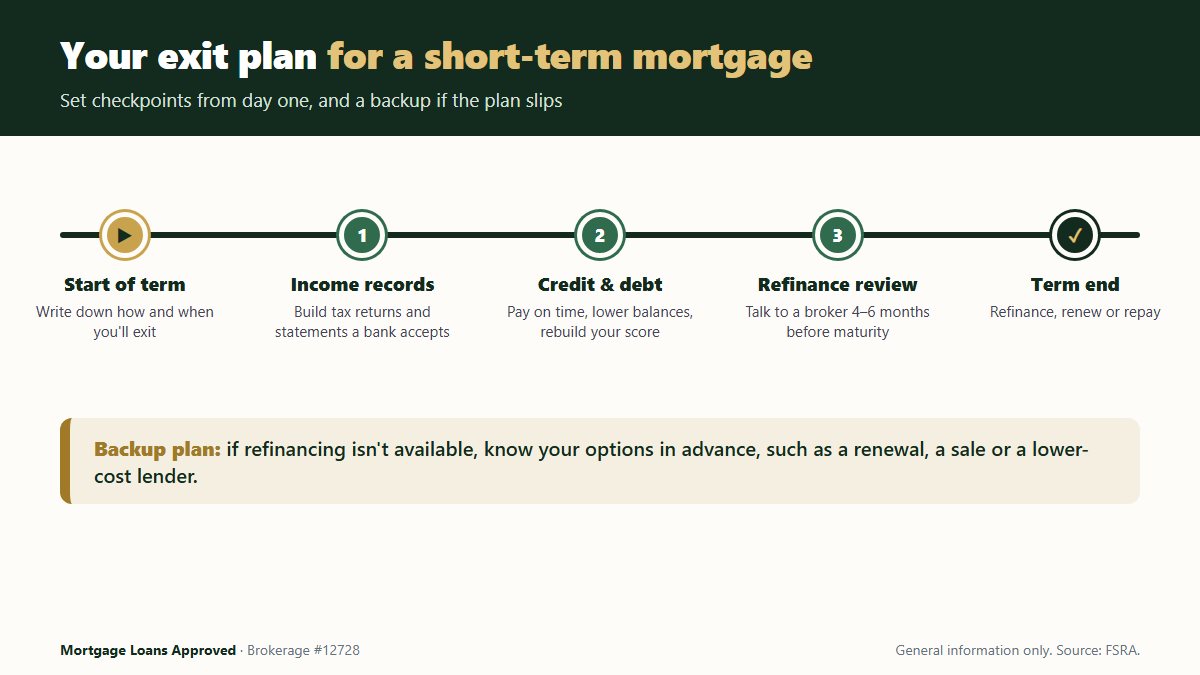
Source: FSRA — Working with a mortgage professional, FSRA — What could happen if you don’t leave a private mortgage
Questions to Ask a Mortgage Broker or Lender
- Why does my application not fit a prime mortgage, and can that issue be resolved?
- Have all realistic lower-cost options been considered?
- What is the total cost, including interest, lender fees, brokerage fees, legal costs, and appraisal expenses?
- Is the payment interest-only, and what balance will be due at the end of the term?
- What exactly must happen for me to refinance or repay the mortgage, and by what date?
- Can I take the contract away to review it and get independent legal advice before signing?
Alternative Mortgage vs. Prime Mortgage: Quick Comparison
| Feature | Prime mortgage | Alternative / private mortgage |
|---|---|---|
| Qualification | Typically follows standard income, credit, debt and property rules | May allow different evidence or risk criteria; requirements still apply |
| Cost | Often lower when the borrower qualifies | May involve higher rates, fees or stricter conditions |
| Term | Varies by product and lender | Private options are often shorter-term; confirm the actual contract |
| Best question | Can I qualify for suitable mainstream financing? | Is the extra flexibility worth the total cost, and is repayment realistic? |
Conclusion
A Non-QM mortgage is a US term; in Canada, borrowers generally compare prime lending with alternative/B-lender and private mortgage options. These products may help when a borrower’s income, credit history, property, or circumstances do not fit a mainstream lender’s policies. The flexibility can be useful, but it should be weighed against the full cost, contract restrictions, and the risk of reaching the end of a short term without an affordable next step.
Whether you are buying a home or refinancing, talk to Mortgage Loans Approved. We compare options across 57+ lenders, including banks, credit unions, B-lenders and private lenders, and show you the full cost before you sign.
Talk to Mortgage Loans Approved today
Phone: 416-710-3239
FAQs
Frequently asked questions
No. Non-QM is primarily a US term. A Canadian B-lender mortgage is one form of alternative institutional lending, but the terminology and rules are different.
Not under that name. Canada has no qualified-mortgage category, so lenders are not described as QM or Non-QM. Borrowers who would look for a Non-QM loan in the US usually compare B-lenders, some credit unions and private lenders in Canada.
Some alternative lenders offer rental mortgages that qualify mainly on the property's rental income, which is similar to a US DSCR loan. Criteria, down payment requirements and rates vary by lender.
Understand the total cost, payment structure, maturity date, default terms, and repayment or exit plan. Ask questions and seek independent legal advice if anything is unclear.
Disclaimer: This article is for general information only and isn't financial or legal advice. Rates, fees and approvals depend on your situation and the lender. Mortgage Loans Approved is a mortgage brokerage operating under Mortgage Architects, FSRA Brokerage Licence #12728.

Founder & Principal Broker at Mortgage Loans Approved, specializing in first-time buyers and newcomers to Canada.