
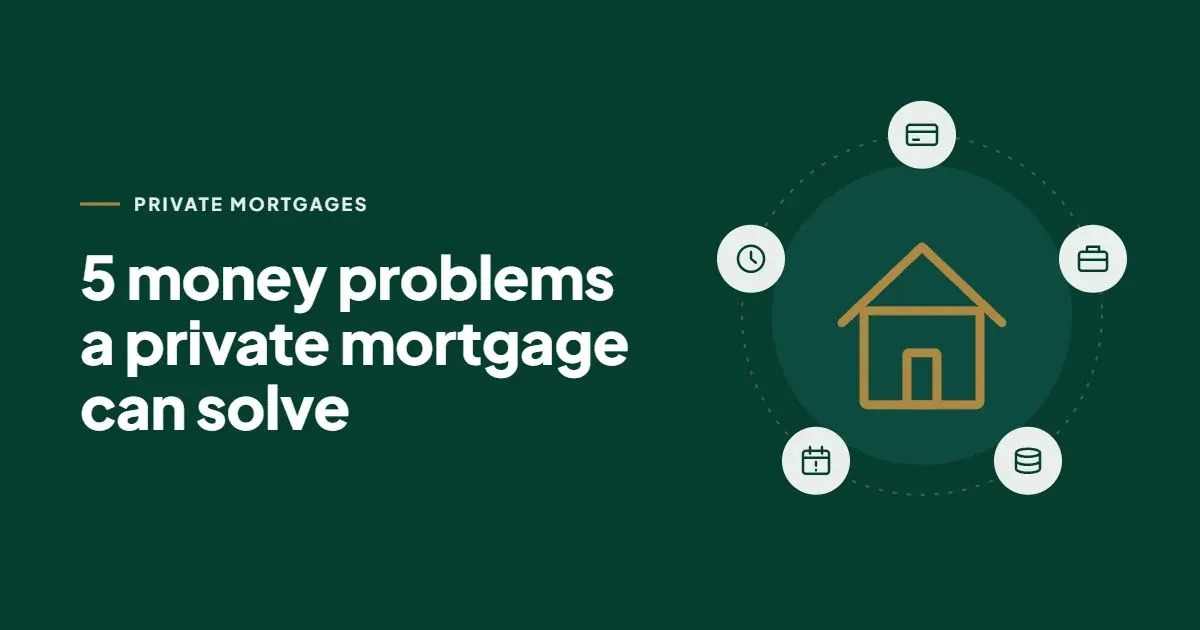
Quick answer: A private mortgage can make sense when you own a home with good equity but a bank won't approve you, or can't approve you fast enough. The five most common reasons are bruised credit, hard-to-prove income, expensive debt, arrears or a power of sale, and a closing that can't wait. It's a short-term bridge, so it only works with a clear exit plan.
Banks follow strict rules on credit scores, income documents and debt ratios. Plenty of responsible Ontario homeowners fall outside those rules for a season. A private mortgage looks mainly at your home's equity and your plan to repay, rather than your credit history alone.
Below are five money problems where a private mortgage is often the right tool, what it costs, and when it isn't the right call.
What is a private mortgage?
A private mortgage is a short-term loan from a private investor or a mortgage investment corporation (MIC), not a bank. Terms usually run one year, sometimes two, and many are interest-only. Private lenders typically lend up to about 75% of your home's value. The goal is to fix the problem, then move you to a bank or B lender at a lower rate before the term ends.
Private lending is one part of Canada's wider alternative lending market. If you've heard the American term "non-QM", our guide on the Canadian equivalent of a non-QM mortgage explains how the two compare.
1. Your credit score is holding you back
Signs: missed payments, a consumer proposal, a past bankruptcy, collections, or a score that dropped after a divorce or job loss.
Banks lean heavily on your credit score. Private lenders focus on your equity and your exit plan, so a low score isn't an automatic no. A private mortgage can give you time to rebuild your credit, then refinance with a bank or B lender.
Learn more about bad credit mortgages in Ontario.
2. You're self-employed or your income is hard to prove
Signs: you write off a lot of expenses, you're new to self-employment, you earn commission or seasonal income, or your income shows up on your T1 General lower than it really is.
A bank may only count the income on your tax return. That can make a successful business owner look unqualified on paper. Private lenders are more flexible about how you show your ability to pay. Some homeowners also qualify through low income mortgage options or a B lender, so it's worth comparing before you go private.
3. High-interest debt is piling up
Signs: credit card balances you can't pay down, a line of credit at its limit, a car loan, CRA debt, or monthly payments that eat most of your paycheque.
If your home has equity, you can use it to pay off expensive debt and replace several payments with one. When a bank or B lender won't approve the debt consolidation, a private first or second mortgage can do it. A second mortgage also lets you keep a low rate on your existing first mortgage, rather than breaking it and paying a prepayment penalty.
4. You're behind on payments or facing a power of sale
Signs: mortgage arrears, unpaid property taxes, a demand letter from your lender, or a Notice of Sale under Mortgage.
This is when speed matters most. A private mortgage can pay out the arrears or the whole mortgage before the lender sells your home. It can protect the equity you've built and give you time to stabilize. If you've received a notice, see our page on stopping a power of sale and call a broker the same day.
5. Your closing can't wait
Signs: your bank financing fell through days before closing, the appraisal came in low, you need a bridge between buying and selling, or a property doesn't fit a bank's rules.
A missed closing can cost you your deposit and expose you to a lawsuit from the seller. Private funding often happens within days once the appraisal and legal work are done. See how we handle last-minute closings.
Bank vs. B lender vs. private lender: how they compare
| Bank (A lender) | B lender | Private lender | |
|---|---|---|---|
| Main focus | Credit score and income | Income and credit, more flexibly | Home equity and exit plan |
| Typical term | 1 to 10 years | 1 to 3 years | 1 to 2 years |
| Rates | Lowest | Moderate | Highest |
| Fees | Usually none | Sometimes a lender fee | Lender and broker fees |
| Speed | Weeks | 1 to 3 weeks | Often within days |
| Best for | Strong credit and documented income | Bruised credit or self-employed income | Urgent, complex or declined files |
What does a private mortgage cost in Ontario?
Private mortgages cost more than bank mortgages. That's the trade-off for flexibility and speed. Expect:
- A higher interest rate than a bank or B lender
- A lender fee and a broker fee, usually a percentage of the loan
- Appraisal and legal costs
In Ontario, these fees should be disclosed to you in writing before you sign, and they're often deducted from the loan funds. Our Private Mortgages page shows an example of how much moving from a private rate to a B lender rate can save. You can run your own numbers with our mortgage payment calculator and refinance calculator.
Why your exit plan matters most
A private mortgage should have an end date and a plan for reaching it. Before you sign, you should know how you'll repay it. The most common exits are:
- Refinance with a bank or B lender once your credit improves or your income is documented. See mortgage refinancing.
- Sell the property, whether it's the home or an investment property.
- Pay it out from a business payout, an inheritance or the sale of another asset.
Without an exit plan, you risk renewing again and again at private rates, with fees each time. Your home is the security for the loan, so falling behind can put it at risk.
When a private mortgage is not the right choice
A private mortgage isn't the answer if:
- You qualify with a bank or B lender, even if it takes a little longer
- You have little equity in your home
- You have no realistic way to repay or refinance within the term
- A smaller tool would do, such as a HELOC or accessing your home equity another way
A good broker will tell you when private isn't the right fit and show you the cheaper options first.
How to get a private mortgage: 5 steps
- Free review: Talk to a licensed broker about your equity, the problem you need to solve and your exit plan.
- Compare offers: Your broker shops your file with private lenders and MICs, and checks B lenders too.
- Appraisal and legal review: The lender confirms the property's value and your lawyer reviews the terms.
- Funding: Funds are released, often within days.
- Move to a lower rate: Work on your exit so you can refinance before the term ends.
Documents you'll usually need: photo ID, your current mortgage statement, your latest property tax bill, home insurance details, and your plan to repay or refinance. See our process for what to expect.
Why work with a licensed Ontario mortgage broker?
In Ontario, mortgage brokers are licensed and regulated by the Financial Services Regulatory Authority of Ontario (FSRA). A broker isn't a lender: the lender makes the final decision. A broker's job is to compare lenders, explain the costs and protect your interests.
Mortgage Loans Approved works with 57+ lenders, including banks, B lenders and private lenders. We help homeowners across the Greater Toronto Area, including Mississauga, Toronto and Brampton. Read our client reviews and case studies.
Talk to us about your options
Facing one of these five money problems? Book a free, no-obligation review with a licensed broker. We'll check whether a bank or B lender could approve you first, and only recommend a private mortgage if it's your best path.
Apply for a mortgage or contact us today.
This article is for general information only and isn't financial or legal advice. Rates, fees and approvals depend on your situation and the lender. Mortgage Loans Approved is a mortgage brokerage operating under Mortgage Architects, FSRA Brokerage Licence #12728.
FAQs
Frequently asked questions
Yes. Private lenders focus mainly on your home equity and your exit plan, not your credit score alone. A low score or a past consumer proposal won't automatically disqualify you if you have enough equity.
Private lenders in Ontario typically lend up to about 75% of your home's value, including any existing mortgages. Strong properties in good locations may qualify for more.
Funding often happens within a few days once the appraisal and legal work are complete. Urgent files, such as a power of sale or a last-minute closing, can sometimes move faster.
Most private mortgages run for one year, sometimes two. Many are interest-only. The goal is to refinance with a bank or B lender before the term ends.
Often, yes. If you have enough equity, a private mortgage can pay out your arrears or your existing mortgage before the property is sold. Act as soon as you receive a Notice of Sale.
It can be, when it's arranged through an FSRA-licensed broker, all fees are disclosed in writing, and you have a clear exit plan. The main risk is renewing at private rates because there's no plan to refinance.
Disclaimer: This article is for general information only and isn't financial or legal advice. Rates, fees and approvals depend on your situation and the lender. Mortgage Loans Approved is a mortgage brokerage operating under Mortgage Architects, FSRA Brokerage Licence #12728.

Founder & Principal Broker at Mortgage Loans Approved, specializing in first-time buyers and newcomers to Canada.