

Ask five people what credit score you need to buy a house in Canada and you’ll probably hear five different answers. 680. 650. 600. “Anything above 700.” Some will even say “it doesn’t matter.”
The truth is that all of those answers can be right, depending on which lender you apply to and how much you’re putting down. A big bank, a B-lender and a private lender each look at your credit score very differently.
At Mortgage Loans Approved, we see this every day. As the owner and a licensed mortgage broker in Ontario and Alberta, Pritpal Singh Kalsi works with 57+ lenders, including A-lenders, B-lenders and private lenders, so we can show you where your score actually lands, not just where a single bank’s cutoff sits. This guide breaks it all down in plain language.
The short answer
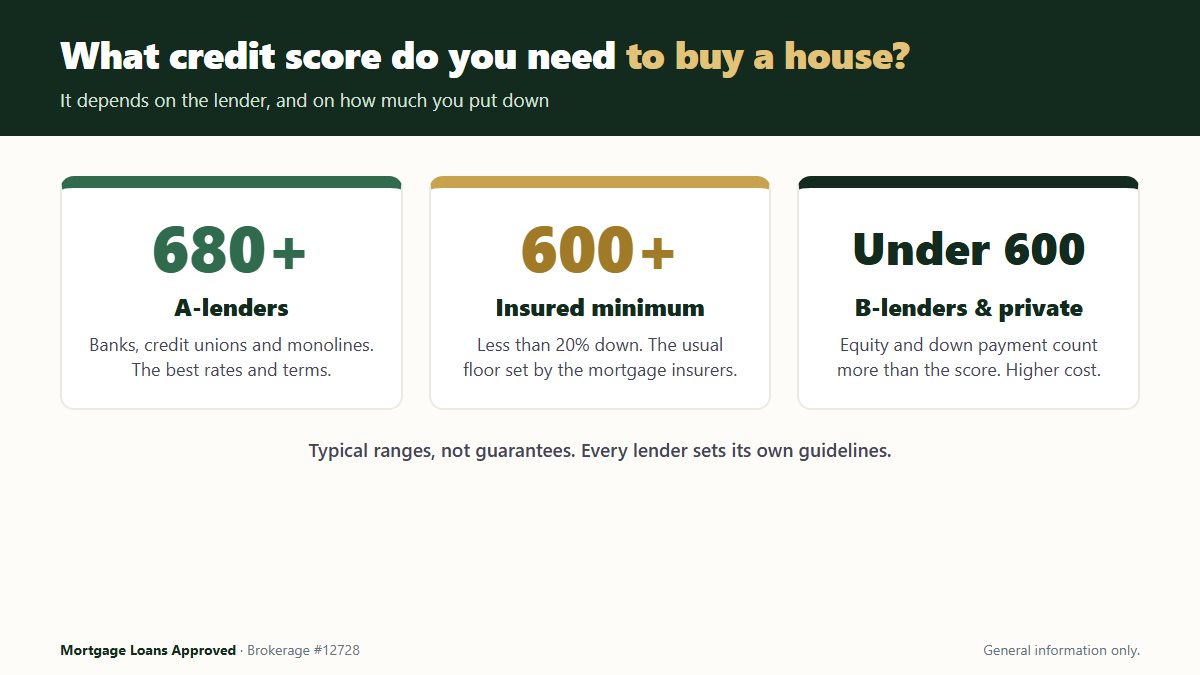
680 or higher: the usual target for A-lenders (banks, credit unions and many monolines) and the strongest position for the best rates.
600 or higher: the typical minimum set by the mortgage insurers (CMHC, Sagen, Canada Guaranty) when you put down less than 20%. Many lenders still prefer 680.
Below 600 (or recently damaged credit): you may still qualify through a B-lender or a private lender, which weigh your equity and down payment more heavily than your score.
How Credit Scores Work in Canada
Canadian credit scores range from 300 to 900 and are calculated by the two national credit bureaus, Equifax and TransUnion. Your two scores are often a bit different because the bureaus may hold slightly different information about you. Lenders may check one or both.
Source: FCAC — Credit report and score basics
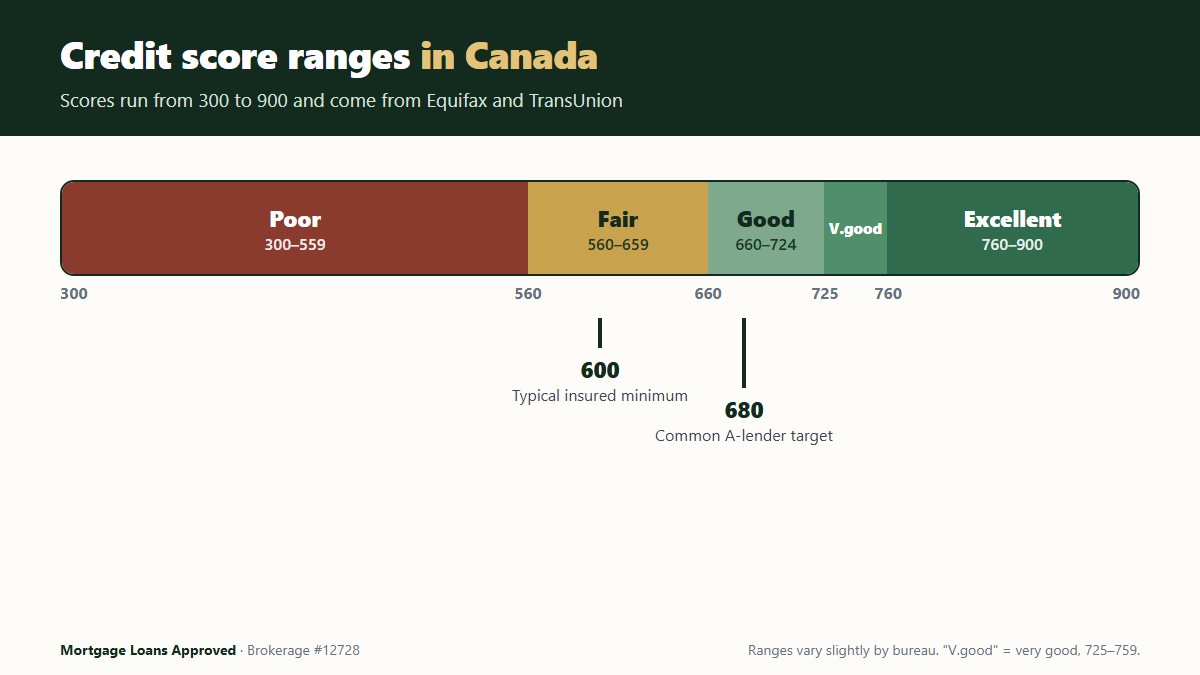
Here are the commonly used score ranges (they can vary slightly by bureau):
| Score range | Rating | What it usually means for a mortgage |
|---|---|---|
| 760 – 900 | Excellent | Access to the widest range of lenders and the best advertised rates |
| 725 – 759 | Very good | Strong approval odds with most A-lenders |
| 660 – 724 | Good | Often approved by A-lenders; 680+ is the common cutoff |
| 560 – 659 | Fair | Insured mortgages possible at 600+; otherwise B-lender territory |
| 300 – 559 | Poor | Typically B-lender or private lender, with equity doing the heavy lifting |
Minimum Credit Score by Lender Type
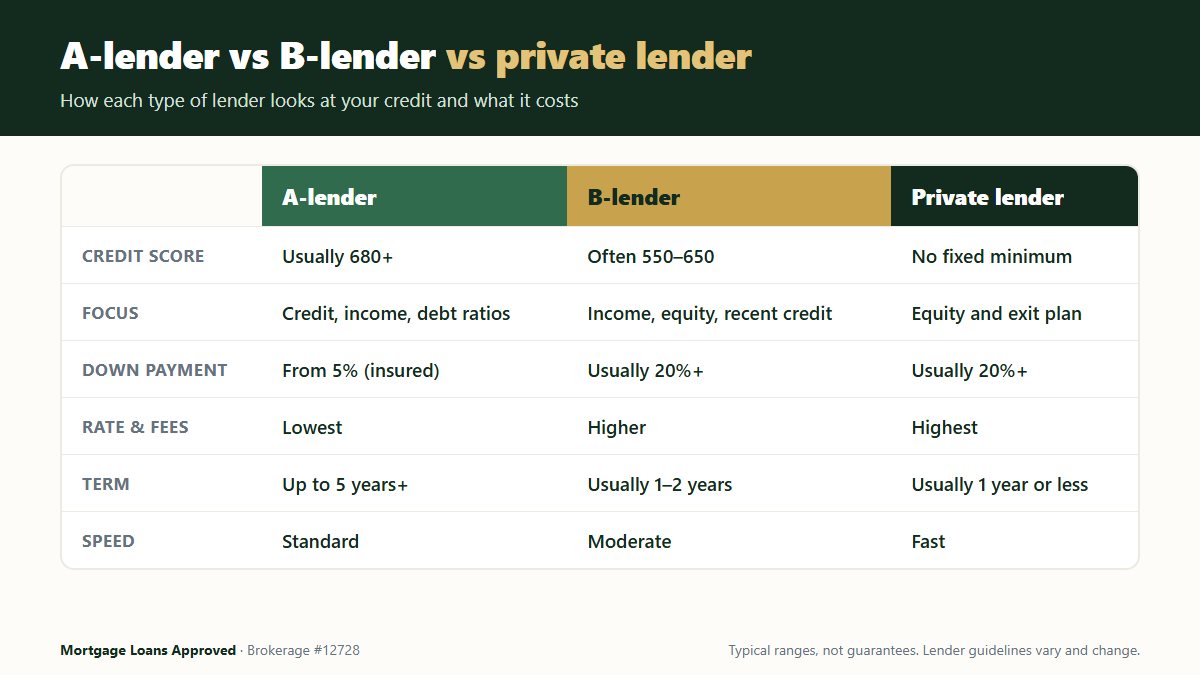
This is the part most articles skip. There is no single national minimum. Each type of lender sets its own comfort zone:
| Lender type | Typical score range | What they focus on | What to expect |
|---|---|---|---|
| A-lenders (banks, credit unions, monolines) | Usually 680+; some will consider about 650 with a strong file | Credit, stable verifiable income, debt ratios, stress test | Lowest rates, longer terms, best prepayment options |
| Insured mortgages (under 20% down) | Insurer floor is typically 600 for at least one borrower; many lenders prefer 680 | Score, income, debt ratios (GDS/TDS) and the 5%/10% down payment rules | Insurance premium added to the mortgage |
| B-lenders (alternative lenders) | Often 550 to 650, depending on the file | Income, down payment or equity, and how recent the credit problem was | Higher rate and fee than A-lenders; shorter terms; designed as a bridge |
| Private lenders | No fixed minimum | Property value, equity (loan-to-value) and a clear exit plan | Highest rates and fees; fast; short terms |
These are typical ranges, not guarantees. Every lender has its own guidelines and they change. A broker with access to many lenders can tell you who is comfortable with your exact numbers.
Why 680 gets quoted so often
Many big-bank A-lenders use 680 as their practical cutoff for strong approvals, even though the insurance rules technically start at 600. That gap is why you’ll see articles saying “680” and others saying “600”. Both can be true. One describes what the insurer allows, and the other describes what many lenders prefer.
Your Down Payment Matters as Much as Your Score
Your credit score and your down payment work together. Under the current federal rules, the minimum down payment for an insured purchase is:
- 5% on the first $500,000 of the purchase price
- 10% on the portion between $500,000 and $1.5 million
- 20% if the purchase price is $1.5 million or more
| Purchase price | Minimum down payment | Down payment at 20% |
|---|---|---|
| $500,000 | $25,000 | $100,000 |
| $800,000 | $55,000 | $160,000 |
| $1,000,000 | $75,000 | $200,000 |
| $1,200,000 | $95,000 | $240,000 |
If you put down less than 20%, your mortgage must be insured, and that is the point where the insurer’s minimum credit score applies. Insured mortgages also have debt-service limits (commonly cited as 39% for gross debt service and 44% for total debt service). Rules like these can change, so we confirm the latest figures with you before you apply.
Source: FCAC — How much you need for a down payment, CMHC — What is mortgage loan insurance?
Your Credit Score Is Only One Piece of the Puzzle
A 750 score doesn’t guarantee approval, and a 620 score doesn’t rule it out. Lenders also look at:
- Income and employment: stability, type (salaried, self-employed, commission) and how it’s documented.
- Debt ratios: how much of your income goes to housing costs and other debts.
- The stress test: proving you could still afford payments at a higher qualifying rate.
- Down payment or equity: more skin in the game lowers the lender’s risk.
- The property: type, location and marketability.
- Credit history details: recent late payments, collections or a consumer proposal can matter more than the number itself.
How Your Score Can Change Your Rate and Payment
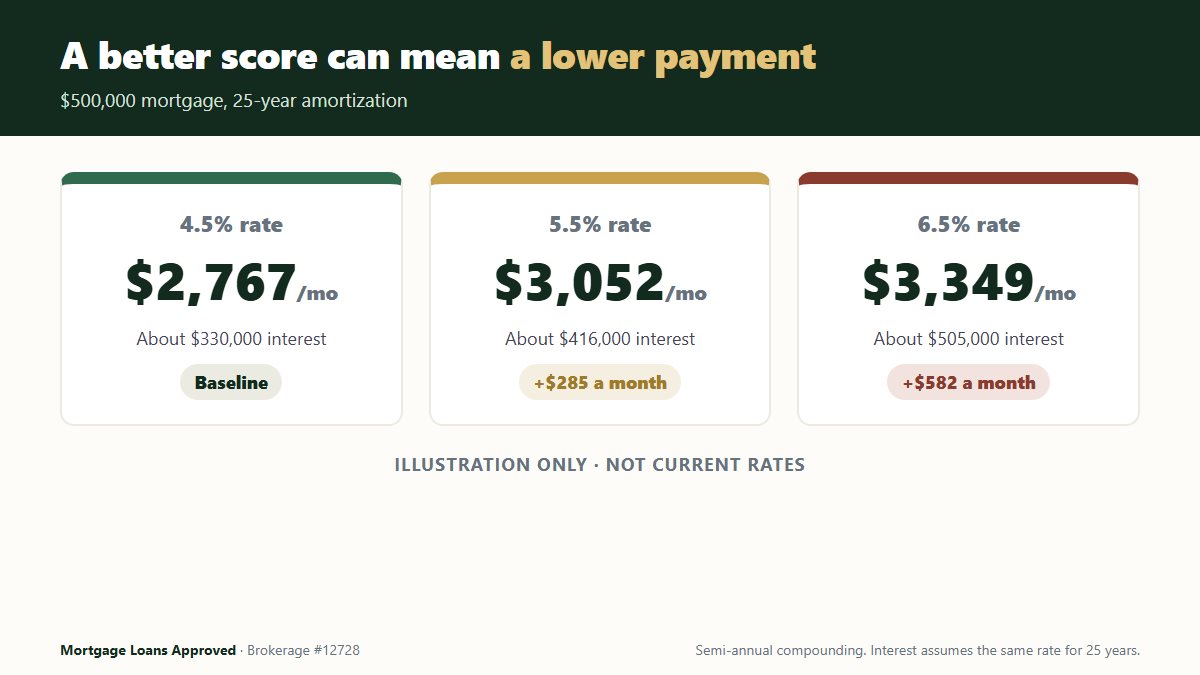
A better score usually opens the door to better rates, and even a small rate difference adds up over 25 years. Here’s an illustration on a $500,000 mortgage with a 25-year amortization (the rates are examples only, not current offers):
| Rate | Monthly payment | Total interest over 25 years | Compared with 4.5% |
|---|---|---|---|
| 4.5% | about $2,767 | about $330,000 | baseline |
| 5.5% | about $3,052 | about $416,000 | +$285 per month |
| 6.5% | about $3,349 | about $505,000 | +$582 per month |
Payments are calculated with standard Canadian semi-annual compounding. Try your own numbers with our mortgage payment calculator.
What If Your Credit Score Is Below 680?
First, don’t panic. A score below 680 closes some doors, but not all of them. Your realistic options usually fall into four paths:
- Improve your score first. If you’re not in a hurry, a few months of focused work can move you into A-lender range (see the next section).
- Apply with a stronger co-borrower. A co-applicant with solid credit and income can change how the file is viewed. Both people are fully responsible for the debt, so think carefully.
- Use a B-lender. B-lenders are more flexible on scores and recent credit issues, with a higher rate and fee, and usually a 1 to 2 year term. The plan is to rebuild and then move to an A-lender. Our guide to alternative mortgage lenders in Canada explains how they work.
- Use a private lender. When the score is very low, income is hard to document or time is short, private lenders look mainly at equity. See our private mortgages and bad credit mortgages pages, and our guide on private vs. traditional mortgages.
Because we work with A-lenders, B-lenders and private lenders, we can tell you which path is the cheapest one that you can realistically get approved for, and map out how to move back to lower-cost financing.
How to Improve Your Credit Score Before Applying
These are the factors that generally influence your score, in rough order of importance:
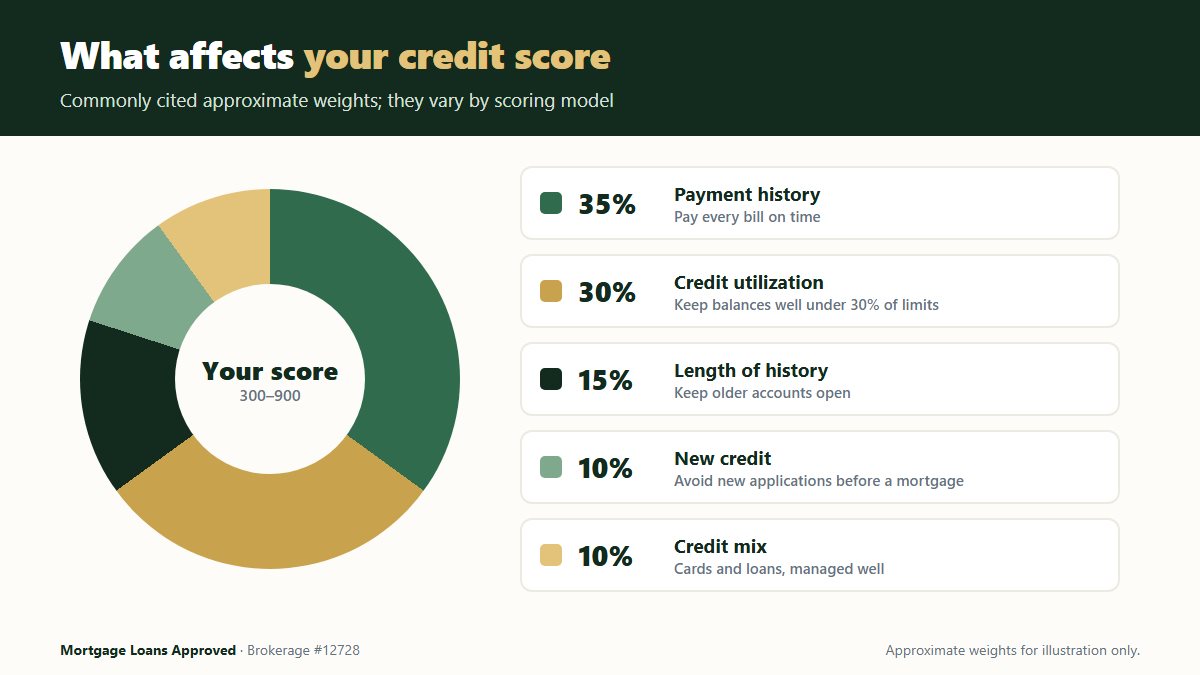
| Factor | Approx. weight | What helps |
|---|---|---|
| Payment history | About 35% | Pay every bill on time; set up automatic payments |
| Credit utilization | About 30% | Keep card balances well under 30% of limits (lower is better) |
| Length of history | About 15% | Keep older accounts open and in good standing |
| New credit / inquiries | About 10% | Avoid applying for new cards and loans before your mortgage |
| Credit mix | About 10% | A healthy mix of cards and loans over time |
Weights are commonly cited approximations and vary by scoring model.
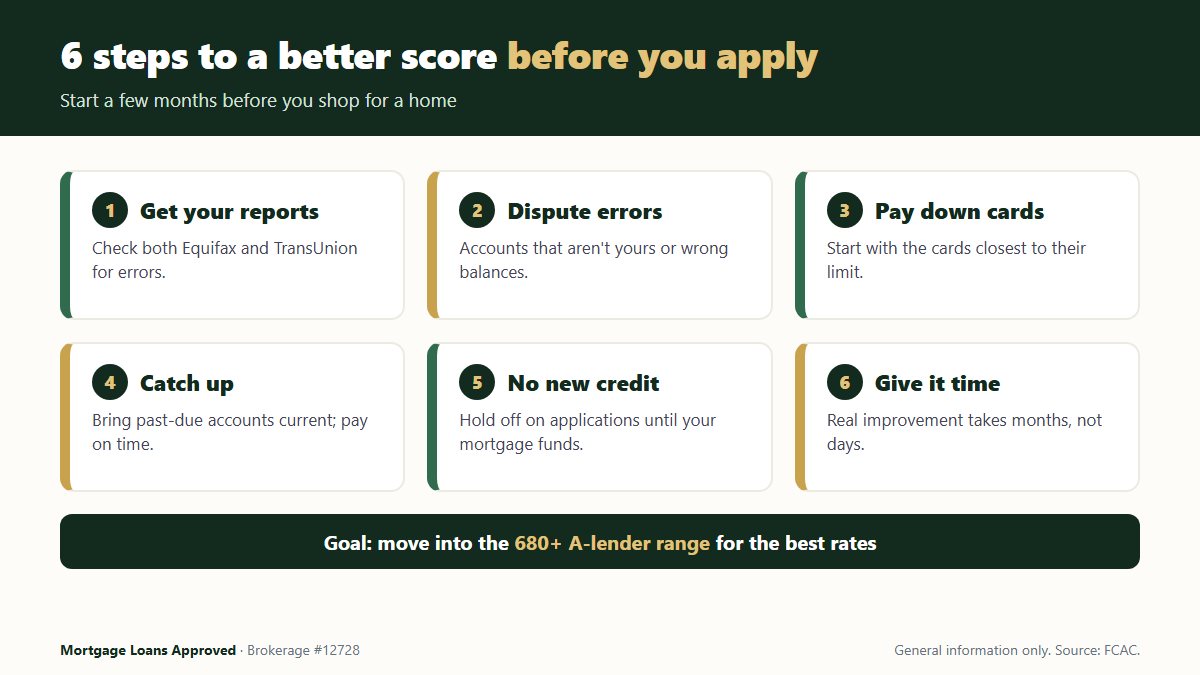
A simple six-step plan:
- Get your credit reports and scores from Equifax and TransUnion and check for errors.
- Dispute anything incorrect, such as accounts that aren’t yours or wrong balances.
- Pay down revolving balances, starting with the highest utilization cards.
- Bring any past-due accounts current and keep every payment on time from now on.
- Hold off on new credit applications until your mortgage is funded.
- Give it time. Meaningful improvement usually takes months, not days.
If you’re carrying high-interest debt, a debt consolidation strategy may also help lower your utilization and monthly obligations. We can review whether it makes sense for your situation.
Common Credit Mistakes Before Applying for a Mortgage
- Opening new credit cards or financing a car or furniture just before applying.
- Closing your oldest credit card, which can shorten your history and raise your utilization.
- Maxing out cards, even if you pay them off every month, since the balance reported on the statement date is what counts.
- Co-signing for someone else without understanding it adds to your own debt picture.
- Ignoring small bills such as phone, utilities or parking tickets that can end up in collections.
- Making a large unexplained deposit right before applying, which lenders will ask you to document.
Special Situations: Proposals, Newcomers and Self-Employed
After a consumer proposal or bankruptcy
A-lenders usually want to see time pass after discharge, along with rebuilt credit, before they’ll consider you. B-lenders and private lenders can often help sooner. The waiting period varies by lender, so ask before assuming you’re locked out.
New to Canada
A short Canadian credit history doesn’t mean you’re rejected, but it does limit your A-lender options at first. Some lenders have newcomer programs, and building a clean history quickly (a card used lightly and paid in full each month) helps.
Self-employed
Your score may be excellent, yet your tax returns may show less income than you really earn. That’s a different problem from low credit, and some lenders handle it better than others. We match self-employed clients with lenders that understand their files; see our guide to self-employed mortgages in Canada.
Will Checking My Credit or Getting Pre-Approved Hurt My Score?
Checking your own credit is a “soft” inquiry and does not affect your score. A lender checking your credit for a mortgage application is a “hard” inquiry, which can cause a small, temporary dip. The Financial Consumer Agency of Canada (FCAC) says that when you get mortgage quotes from different lenders within a 2-week period, the credit bureaus treat them as 1 inquiry, so comparing options is usually fine. A broker can shop your file across lenders without you applying to each one separately.
Source: FCAC — Credit report and score basics, FCAC — Improve your credit score
How Mortgage Loans Approved Helps at Every Credit Score
Most lenders can only offer you what’s on their own shelf. At Mortgage Loans Approved, Pritpal Singh Kalsi, a licensed mortgage broker in Ontario and Alberta, and the team work with 57+ lenders across all three tiers: A-lenders, B-lenders and private lenders. That means:
- One conversation, many options. We compare lenders for you instead of sending you from bank to bank.
- The right lender for your score. We place your file where it fits, not where it gets declined.
- A plan, not just a loan. If you need a B-lender or private mortgage, we map the route back to an A-lender.
- Clear costs up front. You see the rate, fees and terms before you commit.
Not sure where you stand? A quick no-pressure conversation can tell you which tier you’re likely in and what to fix first. See our Purchase and Refinance services, or read about Pritpal Singh Kalsi.
The Bottom Line
A 680 score gives you the widest choice of lenders and the best rates, and 600 is generally the insurer’s floor. But a lower score isn’t the end of the road. With A-lenders, B-lenders and private lenders all in the picture, there is usually a path forward, and often a path back to the best rates later.
The smartest first step is to know exactly where you stand. Talk to the team at Mortgage Loans Approved and get an honest, no-pressure read on your options.
Talk to Mortgage Loans Approved today
Phone: 416-710-3239
Email: pkalsi@mortgageloansapproved.com
Office: 2120 Matheson Blvd East, Suite 201, Mississauga, ON L4W 5E1
Hours: Mon–Fri 9 am – 6 pm, evenings and weekends by appointment
Request a call back or explore all our mortgage solutions.
FAQs
Frequently asked questions
There is no single national minimum. Insured mortgages generally require a score of at least 600 for one borrower, while many banks and other A-lenders prefer 680 or higher. B-lenders and private lenders may approve lower scores, with higher rates and fees.
Possibly. A 600 score may meet the insurer’s minimum, but many lenders still look for a higher score plus strong income and debt ratios. If an A-lender isn’t a fit, a B-lender is often the next option.
It is difficult with an A-lender, but B-lenders and private lenders may be able to help, especially if you have a larger down payment or equity in a property.
The same rules apply to first-time buyers as to everyone else. The score you need depends on your down payment and lender type, though first-time buyers may qualify for programs like the First Home Savings Account and other federal incentives.
Not always. Insurer rules typically look for a minimum score on at least one borrower, but lenders often look at all applicants, so a weaker score on one can still affect the approval and rate.
It depends on what is dragging it down. Correcting errors and lowering card balances can help within a few months, while recovering from missed payments, collections or a proposal takes longer.
Disclaimer: This article is for general information only and isn't financial or legal advice. Rates, fees and approvals depend on your situation and the lender. Mortgage Loans Approved is a mortgage brokerage operating under Mortgage Architects, FSRA Brokerage Licence #12728.

Founder & Principal Broker at Mortgage Loans Approved, specializing in first-time buyers and newcomers to Canada.