

LTV stands for Loan-to-Value ratio. In simple terms, it compares the amount you borrow for a property with the property's lending value or appraised value. LTV is expressed as a percentage and is one of the measurements lenders use when assessing mortgage risk.
Source: CMHC — Home Start: Loan-to-value (LTV) ratios
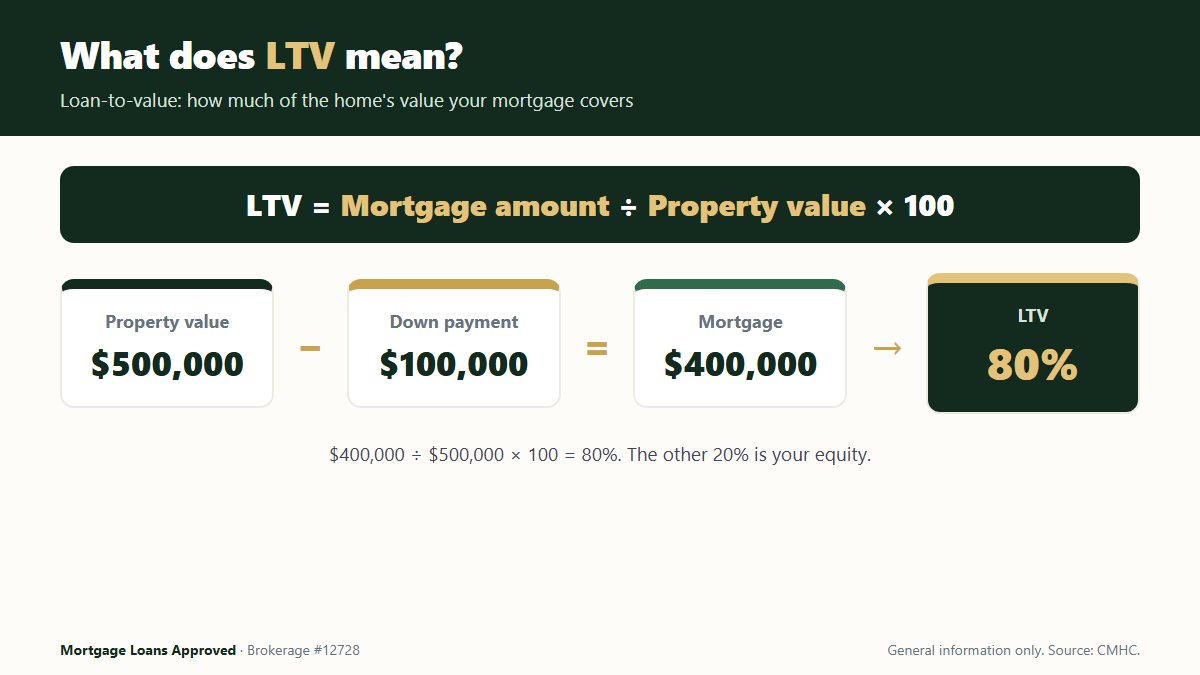
For example, if a home has a lending value of $500,000 and the mortgage amount is $400,000, the LTV is 80%. The remaining 20% represents the borrower's equity before considering other factors such as closing costs or changes in property value.
Understanding LTV is useful because it connects directly to your down payment. Generally, the larger your down payment, the lower your LTV.
How Is LTV Calculated?
The basic calculation is:
LTV = Mortgage Amount ÷ Property Value × 100
Example: You purchase a home for $600,000 and make a $120,000 down payment. Your mortgage before any financed mortgage insurance premium is $480,000.
LTV = $480,000 ÷ $600,000 × 100 = 80%.
So, in this example, your mortgage has an 80% LTV and your down payment represents 20% of the purchase price.
LTV and Your Down Payment
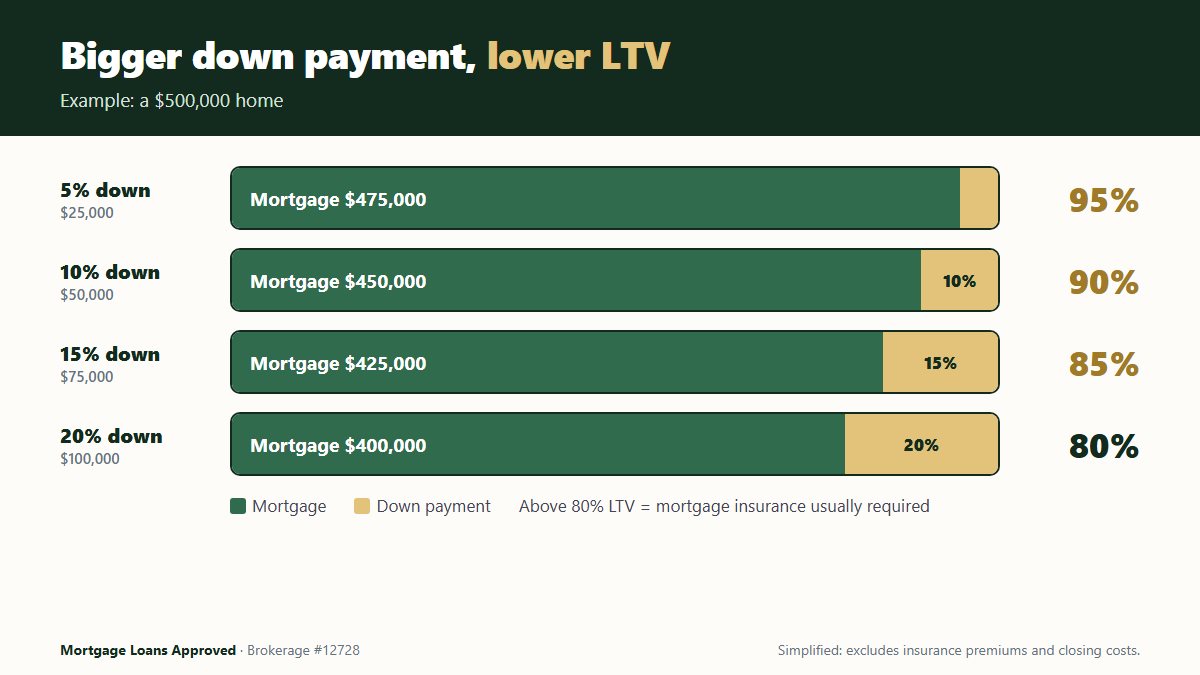
LTV and down payment move in opposite directions. A larger down payment reduces the amount you need to borrow, which lowers your LTV.
| Home Price | Down Payment | Mortgage Amount | LTV |
|---|---|---|---|
| $500,000 | 5% = $25,000 | $475,000 | 95% |
| $500,000 | 10% = $50,000 | $450,000 | 90% |
| $500,000 | 15% = $75,000 | $425,000 | 85% |
| $500,000 | 20% = $100,000 | $400,000 | 80% |
These examples are simplified and do not include mortgage insurance premiums, closing costs or other financing adjustments.
What Does 80% LTV Mean?
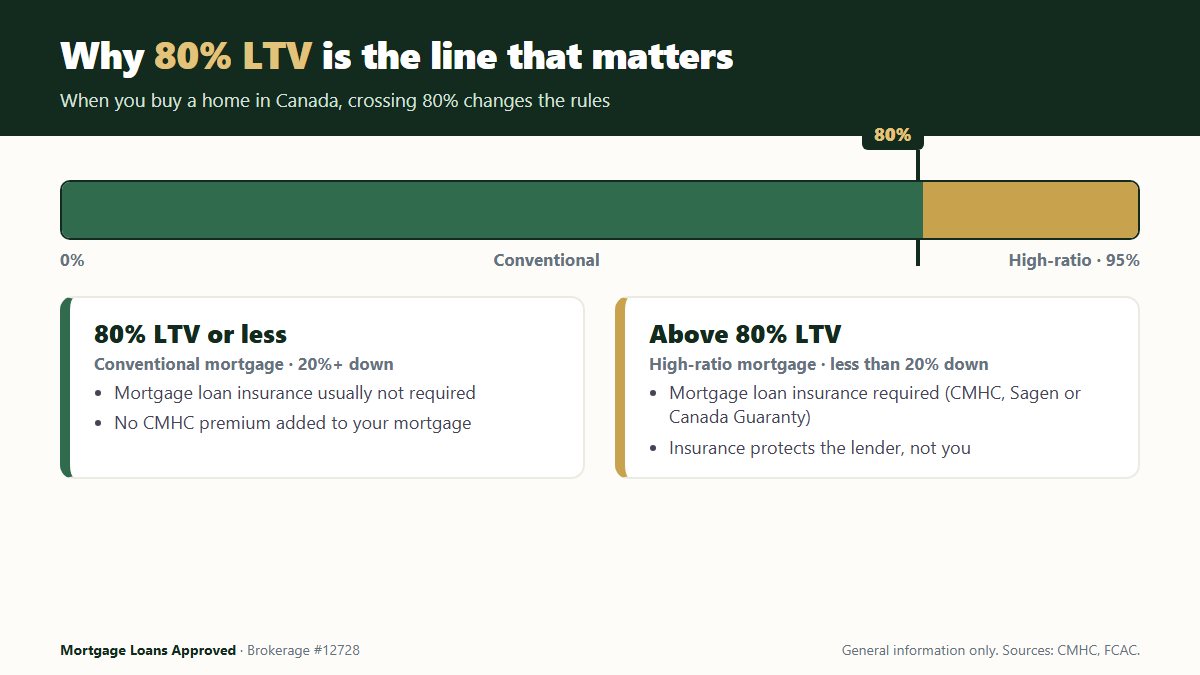
An 80% LTV means the mortgage represents 80% of the property's lending value and the borrower has 20% equity based on that value. In a typical purchase scenario, putting down 20% means you are borrowing 80% of the purchase price.
The 80% level is particularly important in Canada because a down payment below 20% will typically require mortgage loan insurance, subject to the applicable rules and eligibility requirements.
Source: Financial Consumer Agency of Canada — How much you need for a down payment
What Happens When Your LTV Is Above 80%?
An LTV above 80% is generally considered a high-ratio mortgage in Canada. For eligible home purchases, mortgage loan insurance is generally required when the down payment is less than 20%. Mortgage loan insurance protects the lender if the borrower defaults; it does not protect the borrower from the obligation to repay the mortgage.
Source: CMHC — What is CMHC Mortgage Loan Insurance?
For eligible insured homeowner loans, CMHC currently allows LTVs of up to 95% for 1- to 2-unit owner-occupied properties and up to 90% for 3- to 4-unit properties, subject to the program's other requirements. Our guide to high-ratio mortgages in Ontario compares every option above 80% LTV.
Source: CMHC — Home Start
How LTV Affects Mortgage Insurance
For insured mortgages, the mortgage insurance premium is linked to the LTV. Generally, the higher the LTV, the higher the applicable premium rate.
Source: CMHC — Mortgage Loan Insurance Cost
For example, CMHC's current premium schedule for eligible homeowner loans ranges from 0.60% at LTVs up to and including 65% to 4.00% for LTVs from 90.01% to 95%. Different rules can apply to specific products and non-traditional down payments.
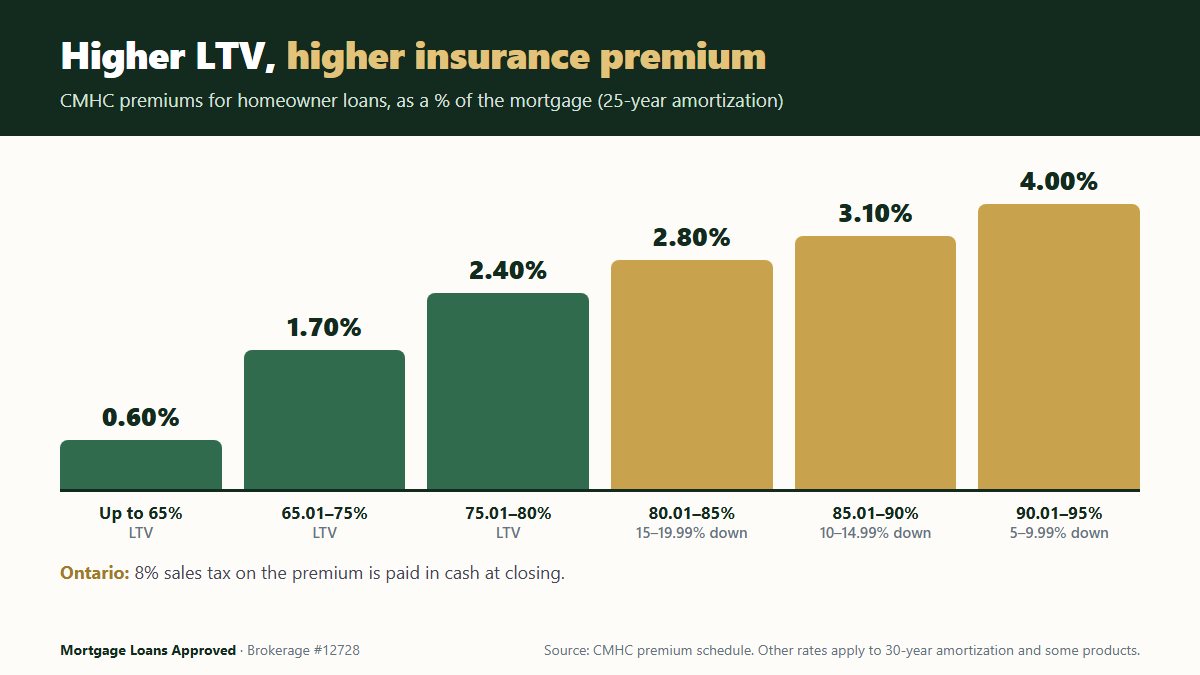
The premium is usually added to the mortgage. In Ontario, 8% provincial sales tax also applies to the premium, and that tax must be paid in cash at closing. See the full premium table, including 30-year amortization rates, in our high-ratio mortgage guide.
Source: CMHC — Mortgage Loan Insurance Premium Information
Does a Lower LTV Always Mean a Better Mortgage?
A lower LTV can reduce the amount you borrow and may reduce or eliminate the need for mortgage loan insurance in a purchase where 20% or more is put down. However, LTV is only one part of mortgage qualification.
Lenders may also consider your income, employment or business situation, credit history, debts, property and ability to make the mortgage payments. A lower LTV does not automatically guarantee approval or a particular interest rate.
If you are planning your purchase, you can also use our mortgage calculators to organize your down payment, borrowing amount and overall mortgage strategy.
LTV vs. Down Payment: What Is the Difference?
Down payment is the amount of money you contribute toward the purchase price. LTV is the percentage of the property's value that is financed by the mortgage.
| Term | What It Means | Example |
|---|---|---|
| Down payment | Your upfront contribution | $100,000 on a $500,000 home |
| Mortgage | Amount financed | $400,000 |
| LTV | Mortgage as a percentage of value | 80% |
| Equity from down payment | Value represented by your initial contribution | 20% |
LTV When You Refinance
LTV can also matter when refinancing an existing mortgage. Instead of simply looking at the original purchase price, the lender may consider the current value of the property and the amount of debt secured against it.
For example, if your home is worth $700,000 and the mortgage balance is $420,000, the simple mortgage-to-value calculation would be 60% LTV.
For most refinances, banks and other federally regulated lenders can lend up to 80% of the home's current value. In this example, 80% of $700,000 is $560,000, so the owner could borrow up to about $140,000 more before costs, subject to approval. Private lenders set their own limits; our private mortgage LTV guide explains how they work.
If you are considering refinancing, explore your mortgage refinance options and ask the lender how the property's current value and total secured debt will be assessed.
What Is a Good LTV Ratio in Canada?
There is no single LTV percentage that is 'best' for every borrower. A lower LTV generally means you are borrowing a smaller percentage of the property's value, while a higher LTV means you are financing more of the property.
- 80% LTV means 20% of the property value is not financed by the mortgage.
- 90% LTV means 10% is represented by the down payment, before considering other adjustments.
- 95% LTV means 5% of the purchase price is represented by the down payment. This is only possible on homes priced at $500,000 or less.
Your preferred LTV should depend on your cash position, mortgage costs, other financial goals and qualification requirements—not simply on trying to reach the lowest possible percentage.
LTV and the Minimum Down Payment in Canada
For eligible home purchases, the current minimum down payment rules depend on the purchase price. The Financial Consumer Agency of Canada states that homes priced at $500,000 or less generally require at least 5% down; for homes above $500,000 and below $1.5 million, the minimum is 5% on the first $500,000 and 10% on the portion above $500,000. Homes priced at $1.5 million or more generally require 20% down.
Example: on a $700,000 home, the minimum is 5% of $500,000 ($25,000) plus 10% of the remaining $200,000 ($20,000), or $45,000. That puts the highest possible LTV on this home at about 93.6%, not 95%.
Source: Financial Consumer Agency of Canada — How much you need for a down payment
These minimums do not mean every borrower will qualify with the minimum down payment. Your lender may require more depending on your financial situation, credit history, property and mortgage program.
What Can Cause Your LTV to Change?
- Making additional mortgage principal payments can reduce your loan balance.
- Changes in property value can change the value used in an LTV calculation.
- Borrowing additional funds secured against the property can increase the debt side of the calculation.
- Refinancing can change the amount of debt secured against the property.
- Purchasing a property with a larger or smaller down payment changes the starting LTV.
Because property valuation and lending policies can vary, the LTV used for a particular mortgage decision should be confirmed with the lender or mortgage professional.
LTV Example: Comparing Two Down Payments
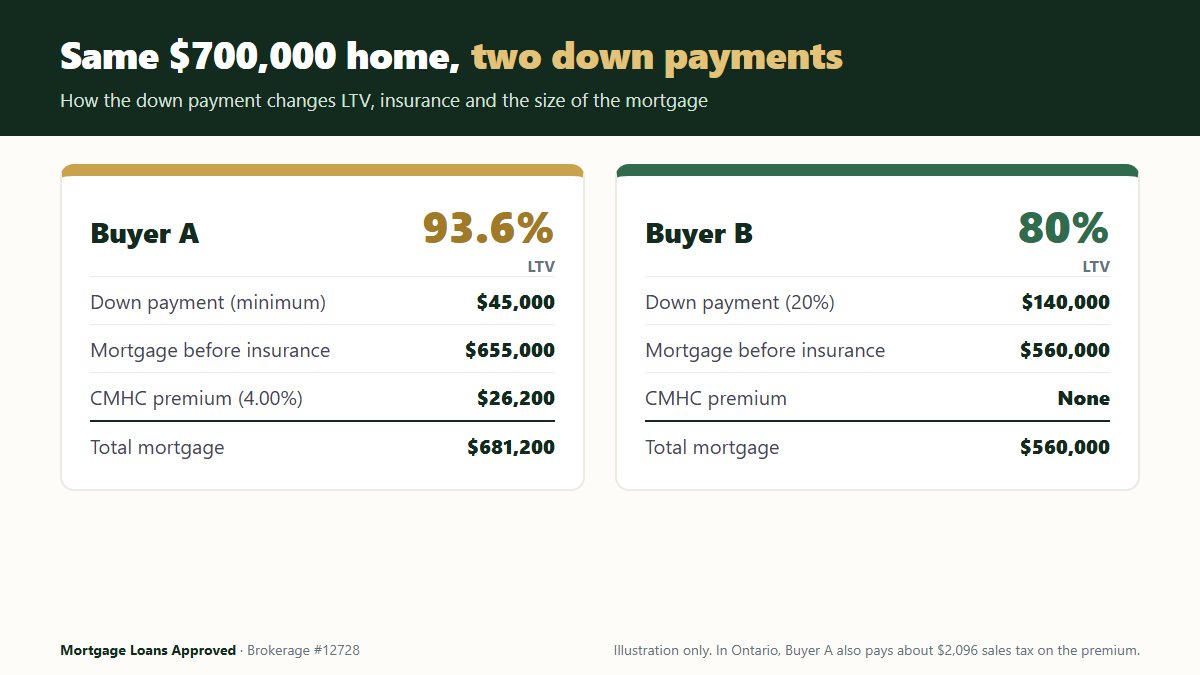
Suppose two buyers are purchasing the same $700,000 home.
| Buyer A | Buyer B | Difference | |
|---|---|---|---|
| Down payment | $45,000 (minimum) | $140,000 (20%) | $95,000 |
| Mortgage before insurance | $655,000 | $560,000 | $95,000 |
| LTV | 93.6% | 80% | 13.6 percentage points |
| CMHC premium (4.00%) | $26,200 | None | $26,200 |
| Total mortgage | $681,200 | $560,000 | $121,200 |
The lower-LTV borrower starts with a smaller mortgage and, for an eligible insured purchase, may not need mortgage loan insurance if the applicable rules are met. The actual mortgage cost will also depend on interest rate, amortization, fees and other factors. In Ontario, Buyer A would also pay about $2,096 in sales tax on the premium at closing.
Can LTV Affect Your Mortgage Options?
Yes. LTV can influence which mortgage products are available and whether mortgage loan insurance is required. Higher-LTV borrowing can be subject to additional underwriting and insurance requirements.
If your financial profile is more complex—for example, if you are self-employed, have credit challenges or need a specialized financing solution—the lender may consider additional factors beyond LTV.
If credit history or income documentation is a concern, you can learn more about bad credit mortgages and low-income mortgage solutions before deciding which mortgage route to explore.
LTV for Self-Employed Borrowers
Self-employed borrowers can face additional income-verification requirements, but LTV remains an important part of the overall mortgage assessment. A strong down payment may improve the equity position, but it does not replace the need to document income and satisfy the lender's qualification criteria.
For borrowers who are self-employed, our guide to mortgage options for self-employed Canadians explains how income documentation and lender options can affect an application.
Common LTV Mistakes to Avoid
- Confusing LTV with the down payment percentage.
- Assuming 20% down automatically guarantees mortgage approval.
- Calculating LTV without considering the lender's accepted property value.
- Assuming mortgage insurance is unnecessary without checking the applicable rules.
- Focusing only on LTV and ignoring income, debt, credit and affordability.
- Assuming the same LTV rules apply to every mortgage product.
Final Thoughts
LTV is one of the simplest mortgage concepts to understand once you connect it to your down payment. It tells you how much of a property's value is being financed by the mortgage.
A lower LTV generally means more equity and less borrowing, while a higher LTV means you are financing a larger share of the property. In Canada, LTV also connects closely with mortgage loan insurance requirements and premiums for eligible insured mortgages.
Before making a decision, you can contact Mortgage Loans Approved to discuss how LTV, down payment, income and other qualification factors may apply to your situation.
Talk to Mortgage Loans Approved today
Phone: 416-710-3239
Email: pkalsi@mortgageloansapproved.com
Office: 2120 Matheson Blvd East, Suite 201, Mississauga, ON L4W 5E1
Hours: Mon–Fri 9 am – 6 pm, evenings and weekends by appointment
Request a call back or explore all our mortgage solutions.
FAQs
Frequently asked questions
LTV stands for Loan-to-Value ratio. It measures the mortgage amount compared with the property's lending value, expressed as a percentage.
Divide the mortgage amount by the property's value and multiply by 100. For example, a $400,000 mortgage on a $500,000 property equals 80% LTV.
80% LTV means the mortgage represents 80% of the property's value. It is an important threshold in Canada because a down payment below 20% will typically require mortgage loan insurance, subject to applicable rules.
Yes. For most refinances, banks and other federally regulated lenders can lend up to 80% of your home's current value, so your LTV decides how much equity you can access. Private lenders set their own limits.
You may reduce the loan side of the calculation by paying down mortgage principal. Changes in property value can also affect the ratio, although lenders may require a valuation when making a specific lending decision.
Disclaimer: This article is for general information only and isn't financial or legal advice. Rates, fees and approvals depend on your situation and the lender. Mortgage Loans Approved is a mortgage brokerage operating under Mortgage Architects, FSRA Brokerage Licence #12728.

Founder & Principal Broker at Mortgage Loans Approved, specializing in first-time buyers and newcomers to Canada.


