


Canada’s big banks have raised both variable and fixed mortgage rates this fall. Variable rates went up after the Bank of Canada’s first interest rate increase since July 2023, and fixed rates had already been climbing for weeks as bond yields rose. Here is what changed, why, and what it means if you are buying, renewing or carrying a variable-rate mortgage.
The Bank of Canada Raised Its Rate to 2.50%
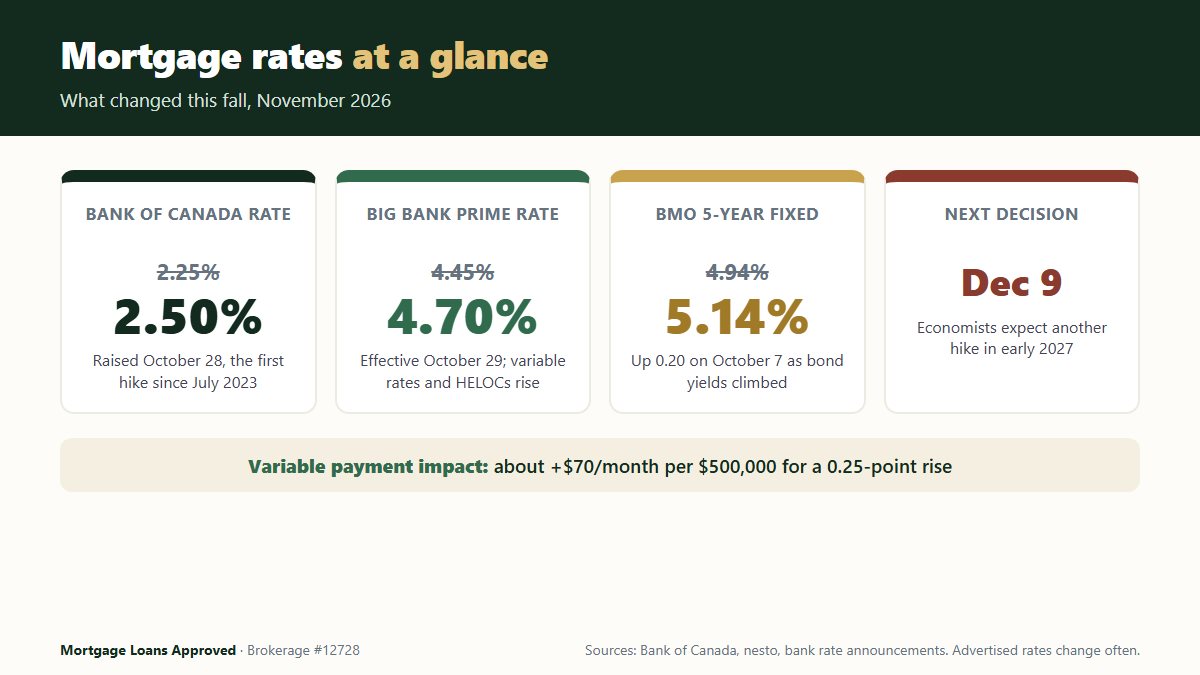
On October 28, 2026, the Bank of Canada raised its policy interest rate by a quarter of a percentage point, from 2.25% to 2.50%. It was the Bank’s first increase since July 2023.
The Bank said it moved to reduce the risk that persistently high energy prices would spread into broader price increases. Inflation has been running at around 3% since April, and the Bank’s staff expect it to rise to about 3½% by the end of 2026 before returning to the 2% target by the middle of 2028. Governing Council said further increases could be needed, but that it will decide one meeting at a time.
Source: Bank of Canada — Summary of Governing Council deliberations, October 28, 2026
Banks Raised Prime to 4.70%: Variable Payments Go Up
Canada’s largest banks passed the increase straight through, raising their prime rates by 0.25 percentage points, from 4.45% to 4.70%, effective October 29. Because variable-rate mortgages and home equity lines of credit (HELOCs) are priced off prime, their interest rates rose the next day.
For a variable-rate mortgage with adjustable payments, a quarter-point increase adds about $70 a month on a $500,000 balance with 25 years left, or about $42 a month on $300,000. If your variable mortgage has fixed payments, your payment may not change, but more of it now goes to interest and less to your principal.
Some lenders had also trimmed the discounts they offer on new variable-rate mortgages earlier in the fall. RBC, for example, reduced its discount on new five-year variable-rate mortgages.
Source: nesto — Bank of Canada raises policy rate to 2.50%
Fixed Rates Rose Too, Driven by Bond Yields
Fixed mortgage rates do not follow the Bank of Canada directly. Lenders price them mainly off Government of Canada bond yields, and the 5-year yield rose to about 3.6% in October, up from about 2.6% earlier in the year. From early September through October, all six big banks raised at least some of their advertised fixed rates:
| Bank | Fixed-rate changes reported this fall |
|---|---|
| BMO | October 7: special 3-year fixed up 0.20 to 4.94%; 5-year fixed up 0.20 to 5.14%; insured 5-year up 0.15 to 4.99% |
| CIBC | October 9: 1- to 4-year fixed up 0.15; 5-year up 0.20 |
| Scotiabank | Early October: 2-year fixed up 0.15 to 5.14% |
| RBC | Early October: 1- to 5-year fixed up 0.10 to 0.20 |
| TD | September 29: 3- and 5-year fixed up about 0.20 |
| National Bank | September: select terms up 0.10 to 0.30 |
Counting all the moves since early September, some TD and RBC terms rose by as much as 0.40 to 0.50 percentage points. These are advertised bank rates; the rate you are offered depends on your file, and lenders change pricing often.
Sources: Immigration News Canada — Canada mortgage rates increase, eAwaz — Canadian mortgage rates rise as major banks increase fixed rates
Latest Inflation Reading and What Comes Next
Statistics Canada reported on November 16 that inflation held at 3.1% in October, unchanged from September and slightly below expectations. Excluding energy, prices rose 2.0%.
Source: Advisor.ca — Inflation unchanged at 3.1% in October
The Bank of Canada’s next rate decision is on December 9, 2026, and its next Monetary Policy Report comes on January 27, 2027. Several bank economists expect at least one more quarter-point increase early in 2027: TD Economics expects one in the first quarter, and BMO and Desjardins each expect one in January. Forecasts change quickly, so treat these as expectations, not certainties.
What It Means for You
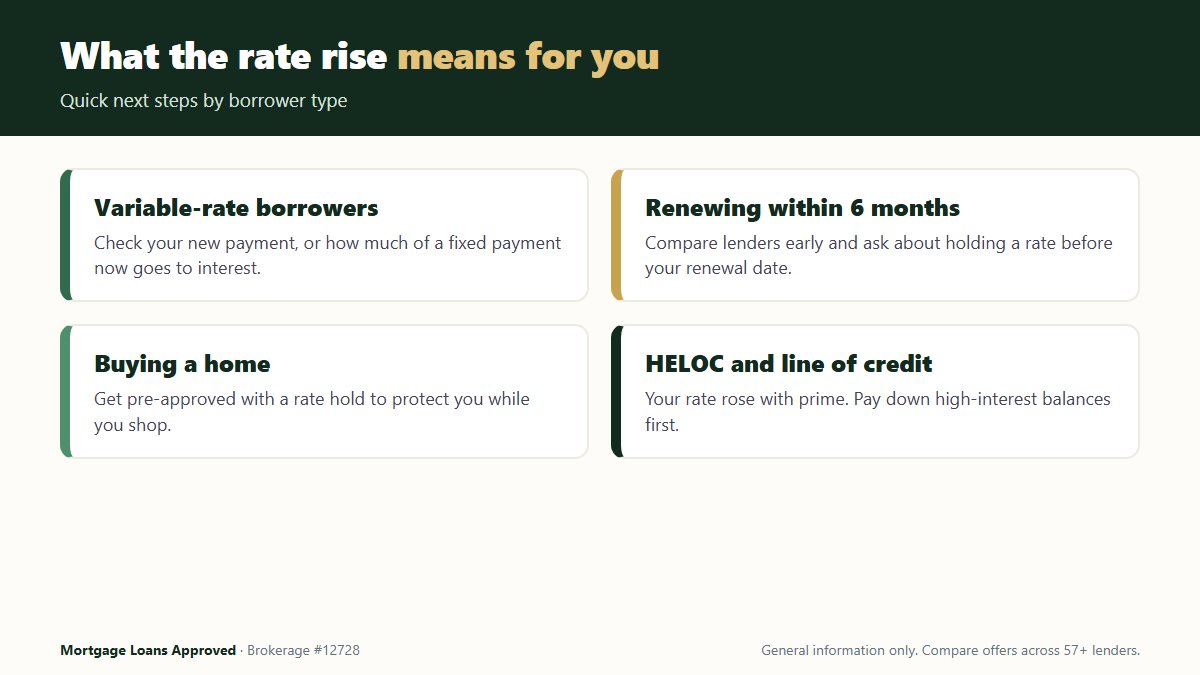
- Variable-rate borrowers: check whether your payment changed or whether more of a fixed payment now goes to interest. If you are considering switching to a fixed rate, ask for the full cost, including any prepayment penalty.
- Renewing in the next 6 months: start comparing early. Many lenders let you hold a rate before your renewal date; see when a mortgage rate hold makes sense and our mortgage renewal checklist.
- Buying a home: a pre-approval with a rate hold can protect you if rates keep rising while you shop. Our guide to what the 2027 rate-increase test means for Ontario buyers explains how higher rates affect qualifying.
- HELOC and line of credit borrowers: your rate rose with prime. Paying down high-interest balances now limits the impact of any further increase.
Rate changes affect every borrower differently. Talk to Mortgage Loans Approved for a free review. We compare current offers across 57+ lenders, including banks, credit unions, B-lenders and private lenders, so you can see your options before you renew, buy or refinance.
Talk to Mortgage Loans Approved today
Phone: 416-710-3239
FAQs
Frequently asked questions
Canada's big banks raised their prime rate from 4.45% to 4.70%, effective October 29, 2026, after the Bank of Canada increased its policy rate to 2.50% on October 28.
The Bank of Canada's next interest rate decision is on December 9, 2026. Its next Monetary Policy Report is due on January 27, 2027.
Fixed mortgage rates are priced mainly off Government of Canada bond yields, not the Bank of Canada's rate. The 5-year bond yield rose to about 3.6% this fall, and all six big banks raised at least some fixed rates between early September and October 2026.
Disclaimer: This article is for general information only and isn't financial or legal advice. Rates, fees and approvals depend on your situation and the lender. Mortgage Loans Approved is a mortgage brokerage operating under Mortgage Architects, FSRA Brokerage Licence #12728.

Founder & Principal Broker at Mortgage Loans Approved, specializing in first-time buyers and newcomers to Canada.