


More Ontario homeowners are falling behind on their mortgage payments than at any time in more than a decade. The share of Ontario mortgages at least 90 days past due rose by about half in a single year, and Canada’s housing agency expects the increase to continue until the middle of 2027.
The numbers are still small: well over 99% of Ontario homeowners are paying on time, and CMHC says “Canada is not facing a broad mortgage crisis.” But the trend matters if you are renewing, carrying a variable rate or already stretched. Here is what is causing the rise, what experts predict for 2027 and what you can do now.
How Much Have Ontario Mortgage Defaults Risen?
When lenders and regulators talk about mortgage “defaults”, they usually mean arrears: payments that are 90 days or more past due. By that measure:
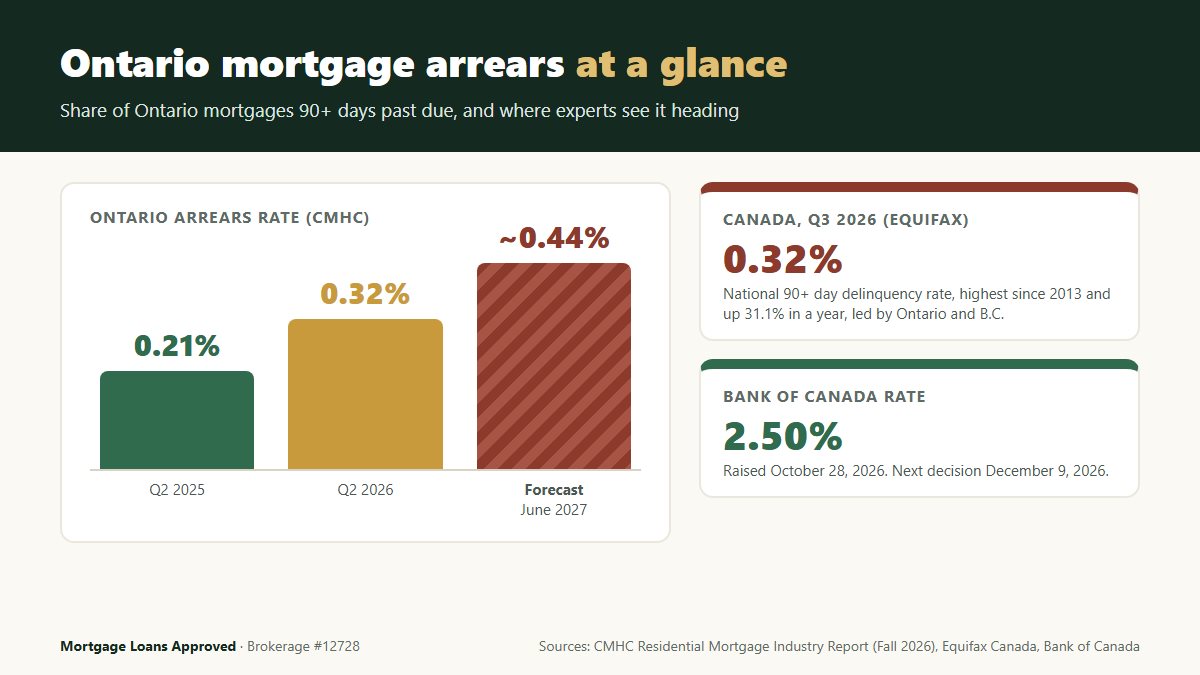
- Ontario’s arrears rate reached 0.32% in the second quarter of 2026, up from 0.21% a year earlier, according to CMHC. Ontario is now above the national average, which is rare.
- Nationally, Equifax Canada reported a 90+ day mortgage delinquency rate of 0.32% in the third quarter of 2026, the highest since it started tracking the measure in 2013 and up 31.1% from a year earlier. Missed payments in Ontario and British Columbia drove most of the increase.
- TD Economics found that Ontario’s arrears have nearly tripled from pre-pandemic levels and are approaching their 2008 financial crisis peak.
“That’s the highest we’ve seen, particularly for Ontario. And it’s still going up,” said Rebecca Oakes, vice-president of advanced analytics at Equifax Canada.
Sources: CMHC – Ontario mortgage arrears expected to rise through mid-2027, CP24 – Mortgage delinquency rate up 31% in Q3, driven by Ontario and B.C.
What Is Causing the Rise in Ontario Mortgage Defaults?
No single cause explains the increase. Several pressures are hitting Ontario households at the same time, and Ontario is more exposed to most of them than other provinces.
1. A Weaker Job Market and Trade Tensions
Job loss is the most common reason a homeowner stops paying a mortgage. CMHC points to trade tensions hitting key manufacturing sectors, including the automotive industry, along with labour-market uncertainty. That is why the increase is concentrated in the Greater Toronto and Hamilton Area (GTHA) and Southwestern Ontario, where many manufacturing and auto jobs are located.
2. Renewal Payment Shock on Large Ontario Mortgages
Many homeowners who bought or refinanced in 2020 and 2021 locked in rates far below today’s. When those mortgages renew, payments can jump by hundreds of dollars a month. Because Ontario home prices are high, mortgage balances are large, so the same rate increase hurts more here. TD economist Maria Solovieva says Ontario’s higher arrears reflect “elevated mortgage balances and greater sensitivity to borrowing costs.”
CMHC believes the largest renewal shock has likely passed, but many borrowers who renewed at higher payments are only now running through their savings.
3. Interest Rates Are Rising Again
On October 28, 2026, the Bank of Canada raised its policy rate from 2.25% to 2.50%, its first increase in more than three years. Banks raised their prime rates the next day, so variable-rate mortgages and home equity lines of credit (HELOCs) became more expensive straight away. Equifax estimates that each quarter-point increase adds roughly $860 million a year in interest costs for Canadians with variable-rate mortgages. Read more in our article on how the big banks raised mortgage rates after the Bank of Canada hike.
4. Falling Home Prices Make It Harder to Sell Your Way Out
In a strong market, a homeowner who cannot keep up can usually sell, pay off the mortgage and walk away with equity. With prices lower in many Ontario markets, that exit is harder. CMHC warns that weak housing market conditions “will continue to make it harder for stressed borrowers to exit through a sale,” which leaves more borrowers stuck in arrears.
5. Condo Investors With Negative Cash Flow
Many investors bought GTA pre-construction condos at peak prices, expecting rents and values to keep rising. Instead, condo sales have slumped. Ontario’s regulator FSRA reports that condo sales in the Greater Toronto Area fell by about 75% between 2022 and early 2025. Investors whose rent no longer covers the mortgage, condo fees and taxes are a growing share of distressed sales and power of sale listings.
6. Stress Shows Up in Other Debts First
CMHC notes that missed payments on car loans, credit cards and lines of credit have been rising, and these often come before mortgage arrears. Most homeowners protect their mortgage payment for as long as they can, so growing non-mortgage delinquencies are an early warning sign. Alternative lenders such as mortgage investment corporations are also seeing more stress than the big banks, because they tend to serve borrowers who are already stretched.
Sources: Canadian Mortgage Professional – CMHC sees Ontario mortgage arrears worsening well into 2027, Bank of Canada – Policy interest rate, FSRA – Mortgage brokering sector supervision plan 2025–26
What Do Experts Predict for 2027?
Most experts expect Ontario mortgage arrears to keep rising into 2027, peak around the middle of the year and then level off, as long as the job market does not get worse and interest rates do not climb much further.
| Source | Outlook for 2027 |
|---|---|
| CMHC | Ontario arrears will keep rising through mid-2027, with the largest and most sustained increase of any province. Its Fall 2026 report projects a rate of about 0.44% by June 2027. B.C. and Atlantic Canada should see a more moderate rise. |
| Equifax Canada | “If interest rates stay relatively flat from this point on, I’d expect to see it ease off in the middle of next year.” (Rebecca Oakes) |
| TD Economics | Ontario arrears are approaching their 2008 peak, driven by large mortgage balances and higher borrowing costs. |
| Bank of Canada | Higher rates are “not a huge headwind” for the economy as a whole (Governor Tiff Macklem). The next rate decisions are on December 9, 2026 and January 27, 2027. |
Three things will decide how 2027 plays out:
- Interest rates. In late November, markets were pricing roughly a 63% chance of another quarter-point increase on December 9. More increases would push arrears higher for longer, especially for variable-rate borrowers.
- Jobs and tariffs. If trade tensions ease and hiring picks up, arrears should peak by mid-2027. More layoffs in manufacturing and autos would push the peak later.
- Home prices. Stable or rising prices make it easier for struggling owners to refinance or sell with equity. Further declines would make more defaults turn into forced sales.
CMHC’s view is worth repeating: delinquency rates are still below the historical peaks of the past 30 years, and this is not a broad crisis. But CMHC also says the “early warning signs, particularly in parts of Ontario, need to be monitored closely.” For individual homeowners, the trend is a reason to plan ahead, not to panic.
Sources: CMHC – Residential Mortgage Industry Report, Fall 2026, CP24 / The Canadian Press
What This Means for Ontario Homeowners
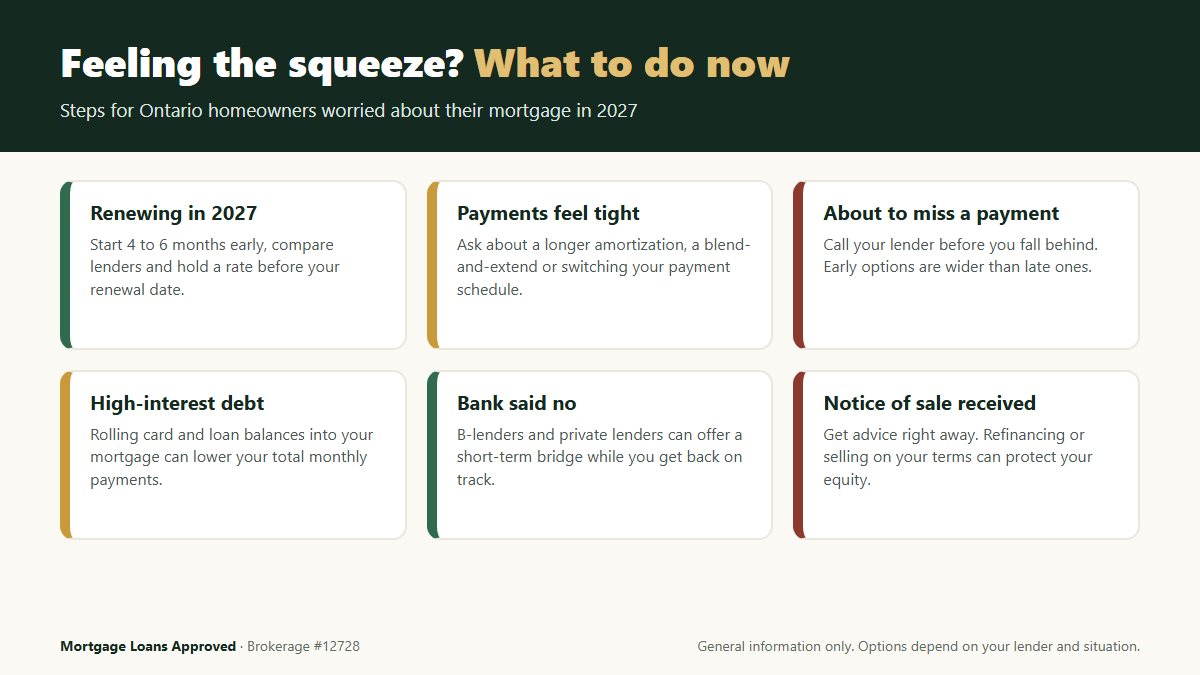
- Renewing in 2027: start four to six months before your renewal date. Compare offers from other lenders rather than signing your current lender’s first offer, and hold a rate if you can. Our mortgage renewal checklist walks you through it, and our mortgage renewal service can compare lenders for you.
- Payments feel tight: ask your lender about extending your amortization, a blend-and-extend or changing your payment schedule. Each option has costs, so ask for the full numbers first.
- About to miss a payment: call your lender before you fall behind, not after. Lenders have more options for borrowers who reach out early.
- Carrying high-interest debt: if card and loan payments are squeezing your mortgage, a debt consolidation mortgage can roll them into one lower monthly payment.
- Turned down by your bank: B-lenders and private mortgages can provide a short-term bridge while you rebuild your credit or income, but they cost more, so have a clear exit plan.
- Already received a notice of sale: act right away. Refinancing or selling on your own terms usually protects far more of your equity than a power of sale.
If you are worried about your renewal or your payments, talk to Mortgage Loans Approved for a free, confidential review. We compare options across 57+ lenders, including banks, credit unions, B-lenders and private lenders, and help you find a plan before a missed payment becomes a bigger problem.
Talk to Mortgage Loans Approved today
Phone: 416-710-3239
FAQs
Frequently asked questions
CMHC reports that 0.32% of Ontario mortgages were 90 or more days past due in the second quarter of 2026, up from 0.21% a year earlier. That is still a small share of borrowers, but Ontario is now above the national average and rising faster than most other provinces.
The main causes are a weaker job market and trade tensions affecting manufacturing and auto jobs, higher payments at renewal on large Ontario mortgage balances, the Bank of Canada’s October 2026 rate increase, lower home prices that make it harder to sell with equity, and GTA condo investors whose rent no longer covers their costs.
CMHC expects Ontario mortgage arrears to keep rising until about mid-2027, projecting a rate of about 0.44% by June 2027. Equifax expects delinquencies to ease around the middle of 2027 if interest rates stay roughly flat. More rate increases or job losses could push the peak later.
Your lender will contact you and charge late fees, and your credit score can drop. Under Ontario’s Mortgages Act, once a payment is at least 15 days in default a lender can issue a notice of sale, which gives you at least 35 days to pay before it can sell the property under power of sale. Calling your lender or a mortgage broker early gives you the most options.
Start shopping four to six months before renewal, compare offers from other lenders and ask about a longer amortization. If debts are the problem, a debt consolidation refinance can lower your total monthly payments. If your bank says no, a B-lender or private mortgage can act as a short-term bridge while you get back on track.
Disclaimer: This article is for general information only and isn't financial or legal advice. Rates, fees and approvals depend on your situation and the lender. Mortgage Loans Approved is a mortgage brokerage operating under Mortgage Architects, FSRA Brokerage Licence #12728.

Founder & Principal Broker at Mortgage Loans Approved, specializing in first-time buyers and newcomers to Canada.